Revision as of 01:26, 25 June 2009 by Sokwe(talk | contribs)(New page: {{Oscillator|name=69P48|pname=69p48|c=69|p=48|bx=19|by=15|h=7.5|animated=true|rle=true}} '''69P48''' is an unnamed period48oscillator tha...)
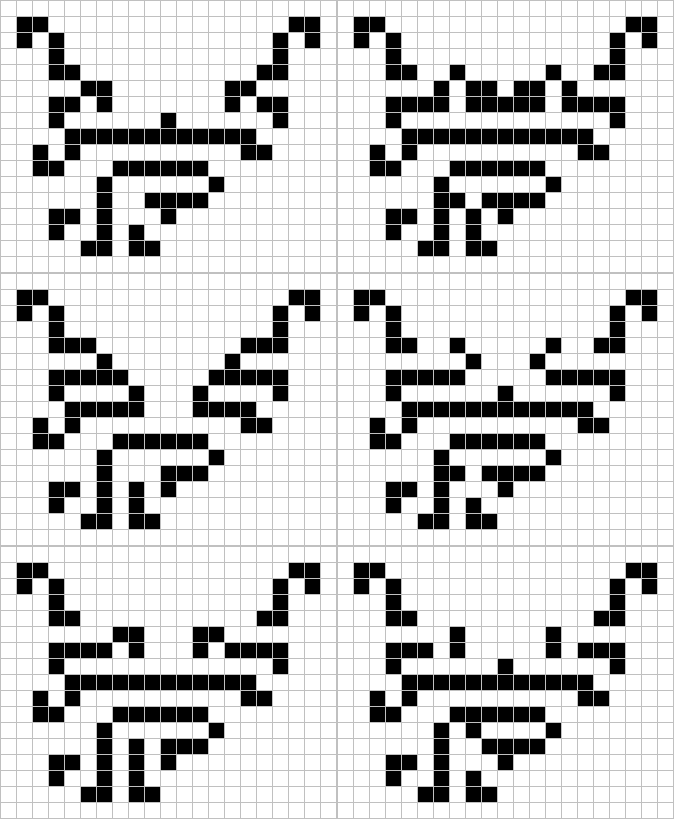
69P48 is an unnamed period48oscillator that is composed of the rotors of both burloaferimeter and the unnamed 55P16 that interact in such a way so as to form a non-trivial period 48 oscillator (figure 1). In terms of its 69 cells, it is the smallest known non-trivial period 48 oscillator.[1]
The oscillator works by having cells from the rotors of both oscillating parts converge in generation 20, causing the death of a single cell in the common stator of each oscillating part in generation 21 (figure 2). This has no effect on the progression of the period 16 rotor, but, in the succeeding two generations, it changes the phase of the burloaferimeter rotor (figure 3) so that it comes back to the state of generation 20 in only 6 generations. Since burloaferimeter oscillates at a period of 7, in the full oscillation of a period 48 oscillator it should oscillate six times and progress another six generations, leaving it just shy of its normal oscillation in 49 generations. The result of the phase change, however, compensates by removing one of the necessary generations required for the burloaferimeter rotor to return to its initial state, resulting in a period of 49 - 1 = 48.
Image gallery
Figure 1: The normal rotors of burloaferimeter (red) and 55P16 (green) and the extra rotor interaction (blue)
Figure 2: Generation 21 shows the single dead cell (light green) that results from overcrowding from the two almost-distinct rotors.
Figure 3: Generation 23 shows the burloaferimeter rotor shifted ahead by one generation.