Bi-block
| Bi-block | |||||||||
| View static image | |||||||||
| Pattern type | Pseudo still life | ||||||||
|---|---|---|---|---|---|---|---|---|---|
| Number of cells | 8 | ||||||||
| Bounding box | 5 × 2 | ||||||||
| Static symmetry | Unspecified | ||||||||
| Discovered by | Unknown | ||||||||
| Year of discovery | Unknown | ||||||||
| |||||||||
| |||||||||
| |||||||||
| |||||||||
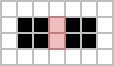
The bi-block is a common formation of two blocks and the smallest and most common[1] pseudo still life. Similar pseudo still lifes can be formed by considering any rectangular array of blocks, some of which are shown below.
Commonness
The bi-block is about ¼ as common as the pond, the most common 8-bit strict still life. Compared to other strict still lifes, it it is more common than the ship-tie but less common than the long boat.[2] In odd orthogonal symmetries, bi-blocks are more common, as gliders in the same phase that collide in odd symmetry form a bi-block.
Counting both strict and pseudo still lifes, the tri-block is the 9th most common 12-bit still life, and it would rank third behind the ship-tie and table on table but ahead of the block on cap if it were strict. Unlike the bi-block, tri-blocks must form by chance.
Image gallery
 RLE: here |
A common predecessor of the bi-block plus one other unrelated block. (click above to open LifeViewer) |
About ⅓ as common as the other LifeViewer pattern, and creates just a bi-block and nothing else. (click above to open LifeViewer) |

|
(click above to open LifeViewer)
|}
References
- ↑ "Census Results in Conway's Game of Life". Online Life-Like CA Soup Search. Retrieved on July 12, 2009.
- ↑ https://catagolue.hatsya.com/census/b3s23/Pseudo_C1/xs8
External links
- Bi-block at the Life Lexicon
- Bi-block at Adam P. Goucher's Catagolue (pseudo-object)