22P36
| 22P36 | |||||||||
| View animated image | |||||||||
| View static image | |||||||||
| Pattern type | Oscillator | ||||||||
|---|---|---|---|---|---|---|---|---|---|
| Number of cells | 22 | ||||||||
| Bounding box | 14 × 18 | ||||||||
| Period | 36 (mod: 36) | ||||||||
| Heat | 19.2 | ||||||||
| Volatility | 0.89 | 0.89 | ||||||||
| Kinetic symmetry | Unspecified | ||||||||
| Discovered by | Noam Elkies | ||||||||
| Year of discovery | 1995 | ||||||||
| |||||||||
| |||||||||
| |||||||||
| |||||||||

- For the period 22 oscillator, see 36P22.
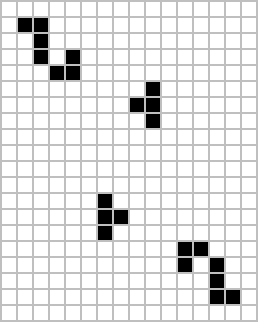
22P36 is an unnamed period-36 oscillator found by Noam Elkies on January 29, 1995.[1] It consists of a double hassling action, in which two colliding traffic lights is first converted by eater 1s into two pair of blinkers and a two blocks. These react to create a pair of blinkers and L-sparks, which then produce then a pair of phi sparks, which are then hassled by the same eaters to produce T-tetrominoes, which re-evolve to traffic lights. In terms of its 22 cells it is the smallest period 36 oscillator.
References
- ↑ Dean Hickerson's oscillator stamp collection. Retrieved on June 16, 2009.
External links
Categories:
- Patterns
- Oscillators with 22 cells
- Periodic objects with minimum population 22
- Patterns with 22 cells
- Patterns found by Noam Elkies
- Patterns found in 1995
- Patterns that can be constructed with 9 gliders
- Oscillators
- Oscillators with period 36
- Oscillators with mod 36
- Oscillators with heat 19
- Oscillators with volatility 0.89
- Oscillators with strict volatility 0.89
- Patterns with 180-degree rotation symmetry
- Unnamed periodic objects
- Semi-natural periodic objects