Acorn
| Acorn | |||||||
| View static image | |||||||
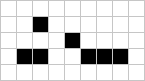
| Pattern type | Methuselah | ||||||
|---|---|---|---|---|---|---|---|
| Number of cells | 7 | ||||||
| Bounding box | 7 × 3 | ||||||
| MCPS | 8 | ||||||
| Lifespan | 5206 generations | ||||||
| Final population | 633 | ||||||
| L/I | 743.7 | ||||||
| F/I | 90.4 | ||||||
| F/L | 0.122 | ||||||
| L/MCPS | 650.8 | ||||||
| Static symmetry | Unspecified | ||||||
| Discovered by | Charles Corderman | ||||||
| Year of discovery | Unknown | ||||||
| |||||||
| |||||||
Acorn is a methuselah found by Charles Corderman. It was discovered no later than 1971[1], though its exact year of discovery is unknown. Its maximum population, 1057, occurs in generation 4408.[2] Also, it is composed of 2 or 3 sparks, depending on how the left side is looked at. Despite this, 4 gliders are required for synthesis. The left spark can be flipped to create another isomer that evolves the same way, and the left spark can also be changed into a V spark.
Stable pattern
The stable pattern that results from the acorn has 633 cells and covers an area of 215 by 168 cells; it consists of 41 blinkers (including four traffic lights), 34 blocks, 30 beehives (including one honey farm), 13 gliders, eight boats, five loaves, three ships, two barges, two ponds and a mango.[3] An eater 1 is temporarily formed at the north side in generation 2661, but does not survive after generation 3925.
-
 Generation 5206

Name
The name was coined by Robert Wainwright "after seeing its final census",[1] which he called "oak tree",[2] apparently alluding to the proverb "From little acorns mighty oaks do grow".
References
- ↑ 1.0 1.1 Lifeline Volume 2, p. 6
- ↑ 2.0 2.1 Lifeline Volume 3, p. 12
- ↑ Koenig, H. (February 21, 2005). "New Methuselah Records". Retrieved on January 24, 2009.
External links
- Acorn at the Life Lexicon