L156
| L156 | |||||
| View static image | |||||
| Pattern type | Conduit | ||||
|---|---|---|---|---|---|
| Conduit type | Composite | ||||
| Input | Herschel | ||||
| Number of cells | 56 | ||||
| Output orientation | Turned left | ||||
| Output offset | (17, -41) | ||||
| Step | 156 ticks | ||||
| Recovery time (ignoring FNG if any) |
62 ticks | ||||
| Minimum overclock period (ignoring FNG if any) |
Unknown | ||||
| Spartan? | Yes | ||||
| Dependent? | No | ||||
| Discovered by | David Buckingham | ||||
| Year of discovery | 1996 | ||||
| |||||
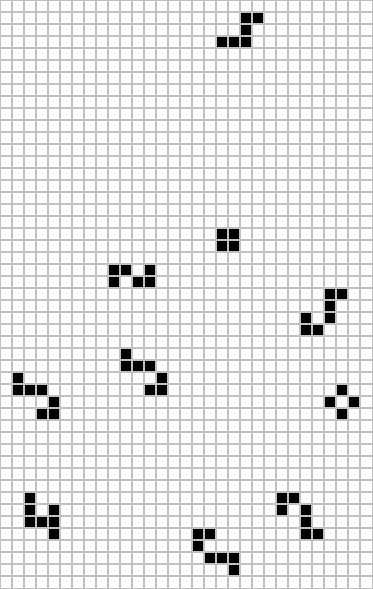
L156 is a composite conduit, one of the original sixteen Herschel conduits, discovered by Dave Buckingham in August 1996. It is made up of three elementary conduits, HLx69R, RF28B, and BFx59H. After 156 ticks, it produces a Herschel turned 90 degrees counterclockwise at (17, -41) relative to the input. Its recovery time is 62 ticks. It can be made Spartan by replacing the snake with an eater 1 in one of two orientations. Additional gliders can be produced by removing the southeasternmost eater, or by replacing the RF28B elementary conduit by an alternate version.
In the pattern shown in the infobox, a ghost Herschel marks the output location.
External links
- L156 at the Life Lexicon