6-in-a-row Cordership
| 6-in-a-row Cordership | |||||||||
| View static image | |||||||||
| Pattern type | Spaceship | ||||||||
|---|---|---|---|---|---|---|---|---|---|
| Family | Cordership | ||||||||
| Number of cells | 213 | ||||||||
| Bounding box | 95 × 99 | ||||||||
| Direction | Diagonal | ||||||||
| Period | 96 (mod: 96) | ||||||||
| Speed | c/12 | Unknown | ||||||||
| Heat | Unknown | ||||||||
| Kinetic symmetry | Unspecified | ||||||||
| Discovered by | Dave Greene | ||||||||
| Year of discovery | 2010 | ||||||||
| |||||||||
| |||||||||
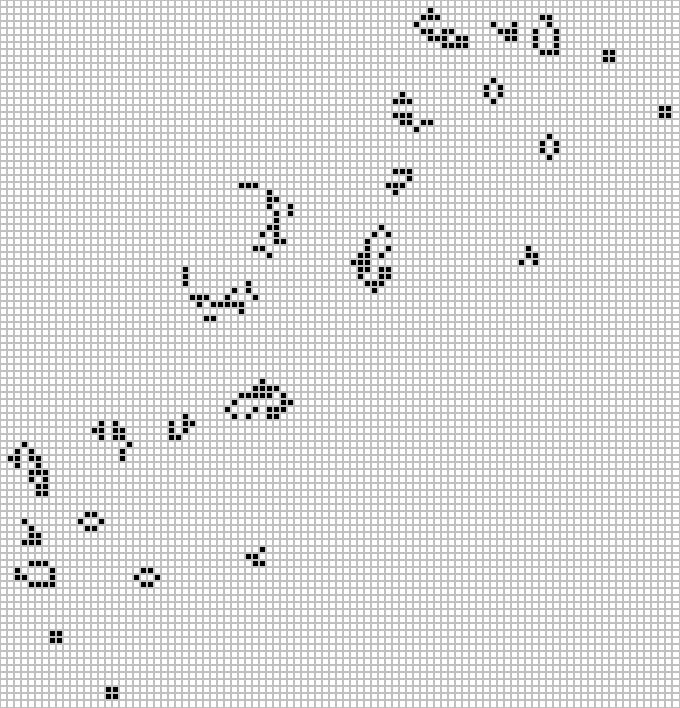
The 6-in-a-row Cordership is a diagonal spaceship that was discovered by Dave Greene on March 13, 2010 while trying to construct a lightweight spaceship rake.[1]
The spaceship consists of the two wings from a 7-in-a-row Cordership, without the central switch engine that requires a 48-tick timing offset between the wings. Like the 5-in-a-row Cordership which also includes one of these wing structures, a simple tub catalyst can be set up to extract one or more gliders from the ship as it passes, by suppressing the creation of a block along the edge.
References
- ↑ Dave Greene (7 August 2016). "Re: Spaceship Discussion Thread". Retrieved on 7 August 2016.
Categories:
- Patterns
- Spaceships with between 200 and 299 cells
- Periodic objects with minimum population between 200 and 299
- Patterns with between 200 and 299 cells
- Patterns found by Dave Greene
- Patterns found in 2010
- Patterns that can be constructed with 21 gliders
- Spaceships
- Spaceships with period 96
- Diagonal spaceships
- Spaceships with speed c/12
- Cordership variants
- Spaceships with mod 96