Bipole
| Bipole | |||||||
| View animated image | |||||||
| View static image | |||||||
| Pattern type | Oscillator | ||||||
|---|---|---|---|---|---|---|---|
| Number of cells | 8 | ||||||
| Bounding box | 5 × 5 | ||||||
| Period | 2 (mod: Unknown) | ||||||
| Heat | 4 | ||||||
| Volatility | 0.40 | 0.40 | ||||||
| Kinetic symmetry | Unspecified | ||||||
| Discovered by | Unknown | ||||||
| Year of discovery | 1970 | ||||||
| |||||||
| |||||||
| |||||||
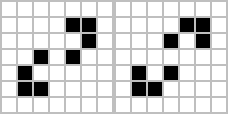

The bipole is the barberpole of length 2 and is thus an oscillator of period 2. It has the same rotor as the blinker.
Commonness
The bipole is the seventh most common oscillator in Achim Flammenkamp's census, being less common than the clock and pentadecathlon but more common than the quadpole.[1]
See also
References
- ↑ Achim Flammenkamp (September 7, 2004). "Most seen natural occurring ash objects in Game of Life". Retrieved on January 15, 2009.
External links
- Bipole at the Life Lexicon
Categories:
- Patterns
- Oscillators with 8 cells
- Periodic objects with minimum population 8
- Patterns with 8 cells
- Patterns found in 1970
- Patterns that can be constructed with 5 gliders
- Oscillators
- Oscillators with period 2
- Oscillators with heat 4
- Oscillators with volatility 0.40
- Oscillators with strict volatility 0.40
- Patterns with 180-degree rotation symmetry
- Flipping oscillators