Fox
| Fox | |||||||
| View animated image | |||||||
| View static image | |||||||
| Pattern type | Oscillator | ||||||
|---|---|---|---|---|---|---|---|
| Number of cells | 12 | ||||||
| Bounding box | 8 × 7 | ||||||
| Period | 2 (mod: Unknown) | ||||||
| Heat | 18 | ||||||
| Volatility | 0.86 | 0.86 | ||||||
| Kinetic symmetry | Unspecified | ||||||
| Discovered by | David Buckingham | ||||||
| Year of discovery | 1977 | ||||||
| |||||||
| |||||||
| |||||||
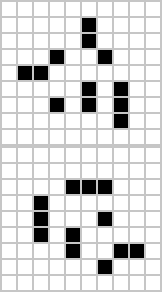
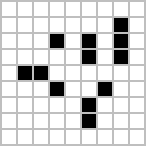
Fox (or gnome[1]) is the smallest period 2 oscillator with an asymmetric rotor. It was found by David Buckingham in July 1977.[2]
References
- ↑ "Gnome". The Life Lexicon. Stephen Silver. Retrieved on June 21, 2011.
- ↑ "Fox". Dean Hickerson's stamp collection. Retrieved on June 21, 2011.
External links
- Fox at the Life Lexicon
Categories:
- Patterns
- Oscillators with 12 cells
- Periodic objects with minimum population 12
- Patterns with 12 cells
- Patterns found by David Buckingham
- Patterns found in 1977
- Patterns that can be constructed with 12 gliders
- Oscillators
- Oscillators with period 2
- Oscillators with heat 18
- Oscillators with volatility 0.86
- Oscillators with strict volatility 0.86