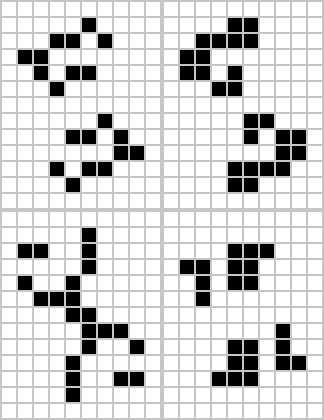
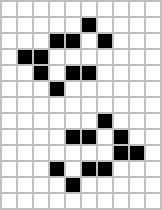
Various names have been proposed for this oscillator, all along the lines of six Ls, including four Ls[2] due to generation 3 consisting of two L sparks and two L-tetrominoes.
It first appeared in an asymmetric soup submitted to Catagolue by Rob Liston on September 8, 2020.[3]
On 2022-10-13, an oscillator with two halves mutually supporting an unnamed object on a hat appeared in a D4_+1 symmetric soup submitted by the Open Science Grid,[5] There is another stabilisation, with two halves instead mutually supporting instead a long hat being perturbed by blocks, of which a stator variant appeared in a soup submitted by Charity Engine on 2022-02-14,[6] a dimer form in one by the Open Science Grid on 2022-10-08.[7]
xp4_1770e6zy0ce0ssg is another period-4 oscillator with two rotationally-symmetrical halves interacting through a two-cell-wide connection, each of which are similar to 20P4's (differing by 1 cell in one phase, then 3, 5 and 7). It has not occurred in an asymmetric soup, but has in asymmetrical ash far from the centre in a C2_1 soup found by Charity Engine on 2022-06-16.[8]
The two next to each other (click above to open LifeViewer)
This second oscillator can in fact be seen as a trans version of the frutterfly.
In other rules
In the canonical phase, if one half is discarded and the L-tetromino has three cells added to make the remaining half rotationally symmetrical (with C2_2), forming two copies of the heptomino, it almost comprises an oscillator (that evolutionarily closely resembles 20P4), but on the fourth iteration two cells in between the heptominos will be born due to the b3q transition, cleanly destroying the pattern in two more iterations. When the b3q transition is removed, however, it works as an oscillator, though 20P4 does not.