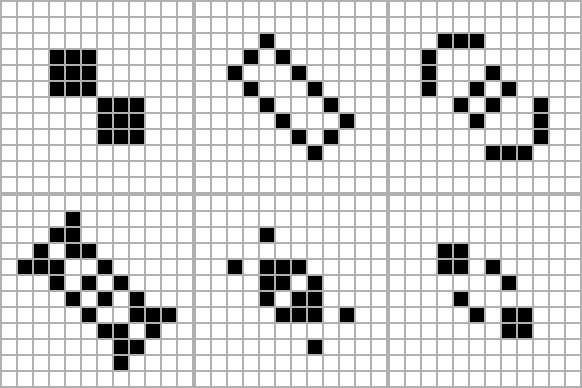
Figure eight

From LifeWiki
Revision as of 17:28, 10 November 2022 by Confocal (talk | contribs)
Jump to navigation Jump to search
Figure eight
2o$2obo$4bo$bo$2bob2o$4b2o! #C [[ THUMBSIZE 2 THEME 6 GRID GRIDMAJOR 0 SUPPRESS THUMBLAUNCH ]] #C [[ AUTOSTART ]] #C [[ GPS 4 THUMBSIZE 3 ZOOM 24 HEIGHT 400 ]]
Pattern type Oscillator
Number of cells 12
Bounding box 10 × 10
Frequency class 23.4
Period 8 (mod: 8)
Heat 16.5
Volatility 1.00 | 1.00
Kinetic symmetry Unspecified
Discovered by Simon Norton
Year of discovery 1970

Figure eight (or less frequently, big beacon[1] or lemniscate) is a period-8 oscillator found by Simon Norton in 1970.[2] With 12 cells in its initial phase, it is the smallest known period 8 oscillator, behind blocker at 15 cells. It is known that no period 8 oscillators exist with 10 or fewer cells.[3]

Producing a domino spark, it is useful for constructing larger oscillators with period that is a multiple of eight. For example, it appears in tumbling T-tetson (period 8), sailboat (period 16), caterer on figure eight (the smallest period-24 oscillator), and a p64 pi-heptomino hassler; the latter two are shown below in Gallery. It is also the key component in the p8 bouncer.

Glider synthesis

A diagonally symmetric collision between two gliders and a teardrop, which costs two gliders, produces a figure eight cleanly, leading to its 4-glider synthesis.

x = 11, y = 11, rule = B3/S23 b2o$o2bo$o2bo$b3o$9b2o$8b2o$10bo2$5bo$4b2o$4bobo! #C [[ THUMBSIZE 2 THEME 6 GRID GRIDMAJOR 0 SUPPRESS THUMBLAUNCH ]] #C [[ ZOOM 12 GPS 5 AUTOSTART T 0 PAUSE 3 T 16 PAUSE 1 T 32 PAUSE 1 LOOP 33 ]]
The reaction of the glider synthesis of figure eight
(click above to open LifeViewer)
RLE: here Plaintext: here

Occurrence

See also: List of common oscillators

Figure eight is the tenth most common naturally-occurring oscillator in Achim Flammenkamp's census, being less common than the great on-off but more common than the spark coil.[4] On Catagolue, it is the most common period 8 oscillator, being more common than blocker.[5]

Figure eight occurs in final patterns of two out of the collisions catalogued in the octo3obj database.[6]

x = 18, y = 6, rule = B3/S23 4b2o6bo$2bob2o4bo3b4o$bo8bo3bo$4bo5bo$2obo9bo$2o9b2o! #C [[ THUMBSIZE 2 THEME 6 GRID GRIDMAJOR 0 SUPPRESS THUMBLAUNCH ]] #C [[ GPS 12 THUMBSIZE 2 ZOOM 14 AUTOSTART ]]
Caterer on figure eight, the smallest known p24 oscillator by population
(click above to open LifeViewer)
RLE: here Plaintext: here
Catagolue: here
x = 30, y = 30, rule = B3/S23 2o26b2o$2obo22bob2o$4bo20bo$bo26bo$2bob2o18b2obo$4b2o18b2o2$9b2o8b2o$ 9bobo6bobo$11bo6bo$9bobo6bobo$9b2o8b2o7$9b2o8b2o$9bobo6bobo$11bo6bo$9b obo6bobo$9b2o8b2o2$4b2o18b2o$2bob2o18b2obo$bo26bo$4bo20bo$2obo22bob2o$ 2o26b2o! #C [[ THUMBSIZE 2 THEME 6 GRID GRIDMAJOR 0 SUPPRESS THUMBLAUNCH ]] #C [[ GPS 32 THUMBSIZE 2 ZOOM 8 HEIGHT 400 AUTOSTART ]]
A p64 pi-heptomino hassler that is supported by the domino sparks of the figure eight
(click above to open LifeViewer)
RLE: here Plaintext: here

See also

References

  1. ↑ "Big beacon". The Life Lexicon. Stephen Silver. Retrieved on June 14, 2011.
  2. ↑ Dean Hickerson's oscillator stamp collection. Retrieved on March 14, 2020.
  3. ↑ Life Period-8 Oscillators at Mark D. Niemiec's Life Page (download pattern file: 12/12fg.rle)
  4. ↑ Achim Flammenkamp (September 7, 2004). "Most seen natural occurring ash objects in Game of Life". Retrieved on January 15, 2009.
  5. ↑ Adam P. Goucher. "Statistics". Catagolue. Retrieved on October 27, 2018.
  6. ↑ The headerless RLEs of the two collisions are 2b2o$2b2o3$4b2o2b2o$2o2b2o2b2o2b2o$2o9b2o$13bo$7b2o$7b2o! and 3b2o$3b2o2b2o$7b2o4$bo5b2o$obo3bo2bo$obo4b2o$bo$9bo$8b2o$8bobo!