Diuresis
| Diuresis | |||||
| |||||
| View animated image | |||||
| View static image | |||||
| Pattern type | Oscillator | ||||
|---|---|---|---|---|---|
| Number of cells | 121 | ||||
| Bounding box | 29 × 25 | ||||
| Period | 90 (mod: Unknown) | ||||
| Heat | Unknown | ||||
| Volatility | Unknown | Unknown | ||||
| Kinetic symmetry | Unspecified | ||||
| Discovered by | David Eppstein | ||||
| Year of discovery | 1998 | ||||
| |||||


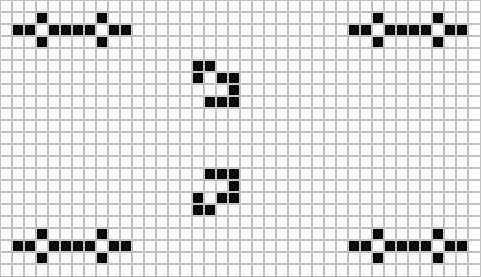
Diuresis is a period 90 oscillator consisting of two bookends hassled by complicated eaters. The original oscillator was found by David Eppstein, and was hassled by pentadecathlons. Later that same day, Dean Hickerson replaced the pentadecathlons with the still life arrangement.
Etymology
The name is due to Bill Gosper, who compared the bookends to kidneys.