Bi-block: Difference between revisions
Jump to navigation
Jump to search
mNo edit summary |
mNo edit summary |
||
| Line 6: | Line 6: | ||
|- | |- | ||
|[[Image:triblock.png|framed|left|A '''tri-block'''<br />{{JavaRLE|triblock|brief}}]] | |[[Image:triblock.png|framed|left|A '''tri-block'''<br />{{JavaRLE|triblock|brief}}]] | ||
|[[Image:block_of_blocks.png|framed|left|A | |[[Image:block_of_blocks.png|framed|left|A 2x3 square of blocks<br />{{JavaRLE|rle=2ob2ob2o$2ob2o2b2o$2ob2ob2o$2ob2ob2o||brief}}]] | ||
|} | |} | ||
Revision as of 17:30, 12 July 2009
| Bi-block | |||||||
| View static image | |||||||
| Pattern type | Pseudo still life | ||||||
|---|---|---|---|---|---|---|---|
| Number of cells | 8 | ||||||
| Bounding box | 5 × 2 | ||||||
| Static symmetry | Unspecified | ||||||
| Discovered by | Unknown | ||||||
| Year of discovery | Unknown | ||||||
| |||||||
| |||||||
| |||||||
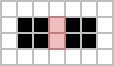
The bi-block is the smallest and most common[1] pseudo still life. It is made up of two blocks. Similar pseudo still lifes can be formed by considering any rectangular array of blocks, some of which are shown below.
Image gallery
 RLE: here |

References
- ↑ "Census Results in Conway's Game of Life". Online Life-Like CA Soup Search. Retrieved on July 12, 2009.
External links
- Bi-block at the Life Lexicon