Bi-block: Difference between revisions
See also: page that was just created |
No edit summary |
||
| Line 21: | Line 21: | ||
Bi-blocks can be hassled by [[spark]]s to create oscillators, such as the [[p18 bi-block hassler]] and [[four molds hassling eight blocks]]. | Bi-blocks can be hassled by [[spark]]s to create oscillators, such as the [[p18 bi-block hassler]] and [[four molds hassling eight blocks]]. | ||
==Commonness== | == Commonness == | ||
The bi-block is about ¼ as common as the pond, the most common 8-bit strict still life. Compared to other strict still lifes, it it is more common than the [[ship-tie]] but less common than the [[long boat]].<ref>https://catagolue.hatsya.com/census/b3s23/Pseudo_C1/xs8</ref> In odd orthogonal symmetries, bi-blocks are more common, as gliders in the same phase that collide in odd symmetry form a bi-block. | The bi-block is about ¼ as common as the pond, the most common 8-bit strict still life. Compared to other strict still lifes, it it is more common than the [[ship-tie]] but less common than the [[long boat]].<ref>https://catagolue.hatsya.com/census/b3s23/Pseudo_C1/xs8</ref> In odd orthogonal symmetries, bi-blocks are more common, as gliders in the same phase that collide in odd symmetry form a bi-block. | ||
Counting both strict and pseudo still lifes, the tri-block is the 9th most common 12-bit still life, and it would rank third behind the ship-tie and [[ | Counting both strict and pseudo still lifes, the tri-block is the 9th most common 12-bit still life, and it would rank third behind the ship-tie and [[mirrored table]] but ahead of the [[block on cap]] if it were strict. Unlike the bi-block, tri-blocks must form by chance. | ||
==Gallery== | == Gallery == | ||
<center> | <center> | ||
{| | {| | ||
| Line 66: | Line 66: | ||
</center> | </center> | ||
==See also== | == See also == | ||
* [[Bi-block hassler]] | * [[Bi-block hassler]] | ||
==References== | == References == | ||
<references /> | <references /> | ||
==External links== | == External links == | ||
{{LinkLexicon|lex_b.htm#biblock}} | {{LinkLexicon|lex_b.htm#biblock}} | ||
{{LinkCatagolue|xs8_rr|format=pseudo-object}} | {{LinkCatagolue|xs8_rr|format=pseudo-object}} | ||
Revision as of 22:46, 24 December 2021
| Bi-block | |||||||||
| View static image | |||||||||
| Pattern type | Pseudo still life | ||||||||
|---|---|---|---|---|---|---|---|---|---|
| Number of cells | 8 | ||||||||
| Bounding box | 5 × 2 | ||||||||
| Static symmetry | Unspecified | ||||||||
| Discovered by | Unknown | ||||||||
| Year of discovery | Unknown | ||||||||
| |||||||||
| |||||||||
| |||||||||
| |||||||||
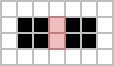
The bi-block is a common formation of two blocks and the smallest and most common pseudo still life. Similar pseudo still lifes can be formed by considering any rectangular array of blocks, some of which are shown below.
Bi-blocks can be hassled by sparks to create oscillators, such as the p18 bi-block hassler and four molds hassling eight blocks.
Commonness
The bi-block is about ¼ as common as the pond, the most common 8-bit strict still life. Compared to other strict still lifes, it it is more common than the ship-tie but less common than the long boat.[1] In odd orthogonal symmetries, bi-blocks are more common, as gliders in the same phase that collide in odd symmetry form a bi-block.
Counting both strict and pseudo still lifes, the tri-block is the 9th most common 12-bit still life, and it would rank third behind the ship-tie and mirrored table but ahead of the block on cap if it were strict. Unlike the bi-block, tri-blocks must form by chance.
Gallery
|
| |||||||
|
|
|
See also
References
External links
- Bi-block at the Life Lexicon
- Bi-block at Adam P. Goucher's Catagolue (pseudo-object)