X66: Difference between revisions
added reference for 9G HWSS on semi-X66 |
replaced image with rle in viewer |
||
| Line 34: | Line 34: | ||
Half of x66 can be supported by a [[heavyweight spaceship]]. A {{gliders|9}} [[synthesis]] for this variant was found on March 8, 2015, from the same reaction used to create the full x66 in 13 gliders.<ref name="post17576" /> Since the heavyweight spaceship is glide symmetric, it can support two halves at once, or one half alongside a [[sidecar]]. | Half of x66 can be supported by a [[heavyweight spaceship]]. A {{gliders|9}} [[synthesis]] for this variant was found on March 8, 2015, from the same reaction used to create the full x66 in 13 gliders.<ref name="post17576" /> Since the heavyweight spaceship is glide symmetric, it can support two halves at once, or one half alongside a [[sidecar]]. | ||
{{EmbedViewer | |||
|rle = 2bo$2o$o2b3o2bo$o4b3o$b3o2b2o2$3b2o$bo4bo$o$o5bo$6o! | |||
| | |position = center | ||
|[[ | |viewerconfig = #C [[ TRACKLOOP 4 -1/2 0 THUMBSIZE 2 GPS 4 ]] | ||
|caption = Half of x66 supported by a heavyweight spaceship<br /> | |||
}} | |||
==See also== | ==See also== | ||
Revision as of 21:49, 20 October 2021
| x66 | |||||||||
| View animated image | |||||||||
| View static image | |||||||||
| Pattern type | Spaceship | ||||||||
|---|---|---|---|---|---|---|---|---|---|
| Number of cells | 34 | ||||||||
| Bounding box | 9 × 11 | ||||||||
| Direction | Orthogonal | ||||||||
| Period | 4 (mod: 4) | ||||||||
| Speed | c/2 | 2c/4 | ||||||||
| Heat | 31 | ||||||||
| Kinetic symmetry | Unspecified | ||||||||
| Discovered by | Hartmut Holzwart | ||||||||
| Year of discovery | 1992 | ||||||||
| |||||||||
| |||||||||
| |||||||||
| |||||||||
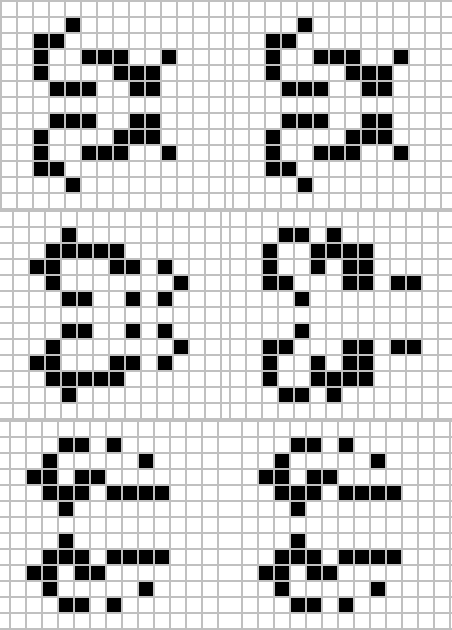

x66 is a period-4 spaceship with speed c/2 that was found by Hartmut Holzwart in July 1992. One of the symmetric halves can alternatively be escorted by a heavyweight spaceship. Its name refers to the fact that every cell (alive or dead) has at most 6 live neighbours (in contrast to spaceships based on lightweight spaceships, middleweight spaceships, or heavyweight spaceships). In fact, this spaceship was found via a search with this restriction. From this follows that the spaceship is stable also in Life-like rules allowing birth or survival for a cell with 7 or 8 neighbors.
x66 was first synthesized on January 11, 2015, requiring 162 gliders.[1] After the emergence of this spaceship in a symmetrical soup on March 8, 2015,[2] this was drastically reduced to 13 gliders,[3] and then to 12 gliders in 2018.[4]
Half of x66 can be supported by a heavyweight spaceship. A 9-glider synthesis for this variant was found on March 8, 2015, from the same reaction used to create the full x66 in 13 gliders.[5] Since the heavyweight spaceship is glide symmetric, it can support two halves at once, or one half alongside a sidecar.
| Half of x66 supported by a heavyweight spaceship (click above to open LifeViewer) |
See also
References
- ↑ Martin Grant (January 11, 2015). "Re: Small Spaceship Syntheses". Retrieved on March 18, 2019.
- ↑ flipper77 (March 8, 2015). "Re: Soup search results". Retrieved on March 18, 2016.
- ↑ Chris Cain (March 8, 2015). "Re: Soup search results". Retrieved on March 18, 2019.
- ↑ 2718281828 (January 15, 2018). "Re: Small Spaceship Syntheses". Retrieved on March 18, 2019.
- ↑ Matthias Merzenich (March 8, 2015). Re: Soup search results (discussion thread) at the ConwayLife.com forums
External links
- x66 at the Life Lexicon
- Glider 10240 at David Eppstein's Glider Database
- x66 at Adam P. Goucher's Catagolue
- 34P4H2V0.23 at Heinrich Koenig's Game of Life Object Catalogs
- Patterns
- Spaceships with 34 cells
- Periodic objects with minimum population 34
- Patterns with 34 cells
- Patterns found by Hartmut Holzwart
- Patterns found in 1992
- Patterns that can be constructed with 12 gliders
- Spaceships
- Spaceships with period 4
- Orthogonal spaceships
- Spaceships with speed c/2
- Spaceships with unsimplified speed 2c/4
- Spaceships with heat 31
- Spaceships with mod 4
- Patterns with bilateral orthogonal symmetry
- Semi-natural periodic objects