Diuresis: Difference between revisions
Jump to navigation
Jump to search
m update statistics |
Per Freywa's decision |
||
| Line 26: | Line 26: | ||
|viewerconfig = #C [[ GPS 10 ZOOM 10 LOOP 90 ]] | |viewerconfig = #C [[ GPS 10 ZOOM 10 LOOP 90 ]] | ||
}} | }} | ||
'''Diuresis''' is a {{period|90}} [[oscillator]] consisting of two [[bookend]]s [[hassle]]d by | '''Diuresis''' is a {{period|90}} [[oscillator]] consisting of two [[bookend]]s being [[hassle]]d by oscillators or stable [[catalyst]]s. The original oscillator was found by [[David Eppstein]] on October 11, {{year|1998}},<ref>{{CiteSummersPattern|name=jslife|accessdate=March 14, 2020}}</ref> and was hassled by [[pentadecathlon]]s. With a minimum population of {{cells|66}} cells, this is still the smallest known form of the oscillator in terms of cell count. Later that same day, [[Dean Hickerson]] replaced the pentadecathlons with the [[still life]] arrangement. The form below shows two still life arrangements, one with the minimal population (left) and one with the minimal bounding box (right). | ||
The name is due to [[Bill Gosper]], who compared the bookends to kidneys. | The name is due to [[Bill Gosper]], who compared the bookends to kidneys. | ||
{{EmbedViewer | |||
|pname = diuresisvariant | |||
| | |position = center | ||
|[[ | |viewerconfig = #C [[ THUMBNAIL THUMBSIZE 2 WIDTH 600 HEIGHT 600 ZOOM 16 AUTOSTART LOOP 90 ]] | ||
|} | |caption = Diuresis supported by stable catalysts | ||
}} | |||
==References== | ==References== | ||
| Line 42: | Line 43: | ||
{{LinkLexicon|lex_d.htm#diuresis}} | {{LinkLexicon|lex_d.htm#diuresis}} | ||
{{LinkCatagolue|xp90_4r4yb4r4z4r4yb4r4zzy03d8ey1e8d3zz0oydoz1u1yb1u1z161yb161}} | {{LinkCatagolue|xp90_4r4yb4r4z4r4yb4r4zzy03d8ey1e8d3zz0oydoz1u1yb1u1z161yb161}} | ||
{{LinkCatagolue|xp90_8k80u178cy8c871s6zwg85ligx6asy4gil9abgzw11da0hyah0ad11zw31pl91xca7y419lp13zy1gs26y862sg|patternname=Diuresis w/ stable catalysts}} | |||
{{Symmetry|orthogonal2|osc=flip}} | {{Symmetry|orthogonal2|osc=flip}} | ||
Revision as of 12:48, 27 July 2021
| Diuresis | |||||||||||
| View animated image | |||||||||||
| View static image | |||||||||||
| Pattern type | Oscillator | ||||||||||
|---|---|---|---|---|---|---|---|---|---|---|---|
| Oscillator type | Shuttle | ||||||||||
| Number of cells | 66 | ||||||||||
| Bounding box | 44 × 27 | ||||||||||
| Period | 90 (mod: 45) | ||||||||||
| Heat | 121.51 | ||||||||||
| Volatility | 1.00 | 0.42 | ||||||||||
| Kinetic symmetry | Unspecified | ||||||||||
| Discovered by | David Eppstein | ||||||||||
| Year of discovery | 1998 | ||||||||||
| |||||||||||
| |||||||||||
| |||||||||||
| |||||||||||

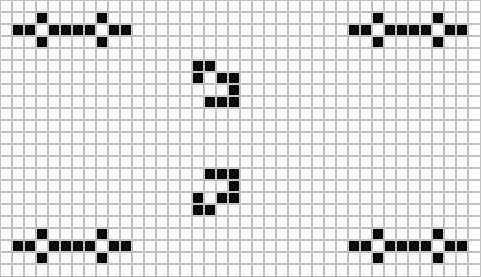
Diuresis is a period-90 oscillator consisting of two bookends being hassled by oscillators or stable catalysts. The original oscillator was found by David Eppstein on October 11, 1998,[1] and was hassled by pentadecathlons. With a minimum population of 66 cells, this is still the smallest known form of the oscillator in terms of cell count. Later that same day, Dean Hickerson replaced the pentadecathlons with the still life arrangement. The form below shows two still life arrangements, one with the minimal population (left) and one with the minimal bounding box (right).
The name is due to Bill Gosper, who compared the bookends to kidneys.
| Diuresis supported by stable catalysts (click above to open LifeViewer) RLE: here Plaintext: here |
References
- ↑ Jason Summers' jslife pattern collection. Retrieved on March 14, 2020.
External links
- Diuresis at the Life Lexicon
Categories:
- Patterns
- Oscillators with 66 cells
- Periodic objects with minimum population 66
- Patterns with 66 cells
- Patterns found by David Eppstein
- Patterns found in 1998
- Patterns that can be constructed with 20 gliders
- Outer-totalistically endemic patterns
- Oscillators
- Shuttles
- Oscillators with period 90
- Oscillators with mod 45
- Oscillators with heat between 120 and 129
- Oscillators with volatility 1.00
- Oscillators with strict volatility 0.42
- Patterns with bilateral orthogonal symmetry
- Flipping oscillators