Sawtooth 201: Difference between revisions
mNo edit summary |
added more refs |
||
| Line 11: | Line 11: | ||
|rle = true | |rle = true | ||
}} | }} | ||
'''Sawtooth 201''' is a diagonal [[sawtooth]] discovered on April 13th, 2015,<ref>{{cite web|url=http://www.conwaylife.com/forums/viewtopic.php?f=2&t=1590#p18666|title=Re: Smaller Sawtooth|author=Adam P. Goucher|date=April 13, 2015|work=ConwayLife.com forums|accessdate=July 3, 2016}}</ref> and was the smallest known sawtooth in terms of its bounding box until the appearance of [[Sawtooth 177|Sawtooth 195]] on October 31st of the same year. It was also smallest in terms of its minimum repeating population of 201, until the appearance of [[Sawtooth 181]] on April 28th. | '''Sawtooth 201''' is a diagonal [[sawtooth]] discovered on April 13th, 2015,<ref name="post18666">{{cite web|url=http://www.conwaylife.com/forums/viewtopic.php?f=2&t=1590#p18666|title=Re: Smaller Sawtooth|author=Adam P. Goucher|date=April 13, 2015|work=ConwayLife.com forums|accessdate=July 3, 2016}}</ref> and was the smallest known sawtooth in terms of its bounding box until the appearance of [[Sawtooth 177|Sawtooth 195]] on October 31st of the same year. It was also smallest in terms of its minimum repeating population of 201, until the appearance of [[Sawtooth 181]] on April 28th. | ||
It functions by letting two glider streams of period 46 retract a block, created by collision with a spark from a [[58P5H1V1]], one cell at a time. The retracted block is deleted via interaction with a [[blocker]], and the streams are allowed to return to the now-farther-away 58P5H1V1 to create another block. | It functions by letting two glider streams of period 46 retract a block, created by collision with a spark from a [[58P5H1V1]], one cell at a time. The retracted block is deleted via interaction with a [[blocker]], and the streams are allowed to return to the now-farther-away 58P5H1V1 to create another block. | ||
| Line 19: | Line 19: | ||
==History== | ==History== | ||
The original design by [[Tanner Jacobi]] used a twin bees shuttle to delete the retracted block, resulting in a population of 213. [[Adam P. Goucher]] noticed that a blocker would suffice on the same day, reducing the population to 201. [[Dave Greene]] optimised the bounding box of the pattern by moving the blocker and spaceship inwards by two full-diagonals and rephasing the blocker by 4 generations; this also reduced the expansion factor from 47<sup>4</sup> to 47. | The original design by [[Tanner Jacobi]] used a twin bees shuttle to delete the retracted block, resulting in a population of 213.<ref name="post18657" /> [[Adam P. Goucher]] noticed that a blocker would suffice on the same day, reducing the population to 201.<ref name="post18666" /> [[Dave Greene]] optimised the bounding box of the pattern by moving the blocker and spaceship inwards by two full-diagonals and rephasing the blocker by 4 generations; this also reduced the expansion factor from 47<sup>4</sup> to 47.<ref name="post18778" /> | ||
Due to a mismatch between the period 46 guns and the period 5 spaceship in the original pattern, full retraction only resulted in the minimum population every fourth cycle. The expansion factor of this pattern is asymptotic to 47 if each of the four sub-tooths per cycle is counted as a separate peak; otherwise the expansion factor is 47<sup>4</sup> = 4,879,681. For the original version of Sawtooth 201, the minimum population recurs at T=0, T=234224640, T=1142941759764480, etc. For Sawtooth 213, the spaceship starts a few cells closer, which makes a big difference to the speed of the cycles, but not to the expansion factor: T=0, T=11232640, T=547659593220480, T=2672404111505817299520, and so on. | Due to a mismatch between the period 46 guns and the period 5 spaceship in the original pattern, full retraction only resulted in the minimum population every fourth cycle. The expansion factor of this pattern is asymptotic to 47 if each of the four sub-tooths per cycle is counted as a separate peak; otherwise the expansion factor is 47<sup>4</sup> = 4,879,681. For the original version of Sawtooth 201, the minimum population recurs at T=0, T=234224640, T=1142941759764480, etc. For Sawtooth 213, the spaceship starts a few cells closer, which makes a big difference to the speed of the cycles, but not to the expansion factor: T=0, T=11232640, T=547659593220480, T=2672404111505817299520, and so on. | ||
==References== | ==References== | ||
<references /> | <references> | ||
<ref name="post18657">{{LinkForumThread | |||
|format = ref | |||
|title = Re: Smaller sawtooth | |||
|p = 18657 | |||
|author = Tanner Jacobi | |||
|date = April 13, 2015 | |||
}}</ref> | |||
<ref name="post18778">{{LinkForumThread | |||
|format = ref | |||
|title = Re: Smaller sawtooth | |||
|p = 18778 | |||
|author = Dave Greene | |||
|date = April 17, 2015 | |||
}}</ref> | |||
</references> | |||
Revision as of 03:26, 18 March 2020
| Sawtooth 201 | |||||||
| View static image | |||||||
| Pattern type | Sawtooth | ||||||
|---|---|---|---|---|---|---|---|
| Number of cells | 201 | ||||||
| Bounding box | 79 × 55 | ||||||
| Expansion factor | 47 | ||||||
| Discovered by | Adam P. Goucher | ||||||
| Year of discovery | 2015 | ||||||
| |||||||
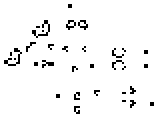
Sawtooth 201 is a diagonal sawtooth discovered on April 13th, 2015,[1] and was the smallest known sawtooth in terms of its bounding box until the appearance of Sawtooth 195 on October 31st of the same year. It was also smallest in terms of its minimum repeating population of 201, until the appearance of Sawtooth 181 on April 28th.
It functions by letting two glider streams of period 46 retract a block, created by collision with a spark from a 58P5H1V1, one cell at a time. The retracted block is deleted via interaction with a blocker, and the streams are allowed to return to the now-farther-away 58P5H1V1 to create another block.
Population
The population is equal to 201 at generations 0, 1840, 88320, 4152880, 195187200, 9173800240, 431168613120, ..., 40 (47n - 1), ... ( A257319), giving an expansion factor of 47.
History
The original design by Tanner Jacobi used a twin bees shuttle to delete the retracted block, resulting in a population of 213.[2] Adam P. Goucher noticed that a blocker would suffice on the same day, reducing the population to 201.[1] Dave Greene optimised the bounding box of the pattern by moving the blocker and spaceship inwards by two full-diagonals and rephasing the blocker by 4 generations; this also reduced the expansion factor from 474 to 47.[3]
Due to a mismatch between the period 46 guns and the period 5 spaceship in the original pattern, full retraction only resulted in the minimum population every fourth cycle. The expansion factor of this pattern is asymptotic to 47 if each of the four sub-tooths per cycle is counted as a separate peak; otherwise the expansion factor is 474 = 4,879,681. For the original version of Sawtooth 201, the minimum population recurs at T=0, T=234224640, T=1142941759764480, etc. For Sawtooth 213, the spaceship starts a few cells closer, which makes a big difference to the speed of the cycles, but not to the expansion factor: T=0, T=11232640, T=547659593220480, T=2672404111505817299520, and so on.
References
- ↑ 1.0 1.1 Adam P. Goucher (April 13, 2015). "Re: Smaller Sawtooth". ConwayLife.com forums. Retrieved on July 3, 2016.
- ↑ Tanner Jacobi (April 13, 2015). Re: Smaller sawtooth (discussion thread) at the ConwayLife.com forums
- ↑ Dave Greene (April 17, 2015). Re: Smaller sawtooth (discussion thread) at the ConwayLife.com forums