Max: Difference between revisions
Jump to navigation
Jump to search
mNo edit summary |
|||
| Line 32: | Line 32: | ||
[[Category:Infinite growth]] | [[Category:Infinite growth]] | ||
[[Category:Breeders]] | |||
Revision as of 18:14, 31 March 2019
| Max | |||||||
| View static image | |||||||
| Pattern type | Spacefiller | ||||||
|---|---|---|---|---|---|---|---|
| Number of cells | 187 | ||||||
| Bounding box | 27 × 27 | ||||||
| Static symmetry | Unspecified | ||||||
| Discovered by | Tim Coe | ||||||
| Year of discovery | 1995 | ||||||
| |||||||
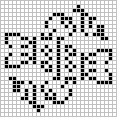
Max is a spacefiller that was found by Tim Coe[1] in October 1995 that fills the plane with zebra stripes. In terms of its 187 cells, it is tied with spacefiller 2 as the smallest known spacefiller, and in terms of its 27×27 bounding box it wins outright.[2]
Alternatively, the term Max may be used to describe whatever the smallest-known spacefiller is at the current time. The term represents the fact that the growth rate is the fastest possible of any pattern in Conway's Game of Life.[3][4]
Image gallery
 |
See also
References
- ↑ "Coe's improvements on the spacefiller". Paul Callahan. Retrieved on June 10, 2011.
- ↑ Spacefiller.lif in Alan Hensel's lifebc.zip pattern collection.
- ↑ "Max". The Life Lexicon. Stephen Silver. Retrieved on May 24, 2009.
- ↑ Eric Weisstein. "Max". Eric Weisstein's Treasure Trove of Life C.A.. Retrieved on May 24, 2009.
External links
- Max at the Life Lexicon