Phoenix 1: Difference between revisions
Jump to navigation
Jump to search
m fc |
m Removed Life 1.05 and 1.06 |
||
| Line 21: | Line 21: | ||
|synthesis = 6 | |synthesis = 6 | ||
|synthesisRLE = true | |synthesisRLE = true | ||
|plaintext = true | |plaintext = true | ||
|rle = true | |rle = true | ||
Revision as of 19:39, 27 January 2019
| Phoenix 1 | |||||||||
| View animated image | |||||||||
| View static image | |||||||||
| Pattern type | Oscillator | ||||||||
|---|---|---|---|---|---|---|---|---|---|
| Oscillator type | Phoenix | ||||||||
| Number of cells | 12 | ||||||||
| Bounding box | 8 × 8 | ||||||||
| Frequency class | 41.4 | ||||||||
| Period | 2 (mod: 1) | ||||||||
| Heat | 24 | ||||||||
| Volatility | 1.00 | 1.00 | ||||||||
| Kinetic symmetry | Unspecified | ||||||||
| Rotor type | Flutter | ||||||||
| Discovered by | MIT group | ||||||||
| Year of discovery | 1971 | ||||||||
| |||||||||
| |||||||||
| |||||||||
| |||||||||

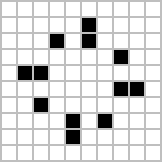
Phoenix 1 (or flip-flops[1]) is a period 2 oscillator that was discovered by the MIT group in December 1971. It is the smallest known phoenix as well as the first discovered phoenix, and is thus sometimes simply referred to as the phoenix.
Phoenix 1 consists of four identical three-cell segments, chained in a loop. Other arrangements are possible, to generate larger period 2 phoenices as shown below. A single copy of this rotor can also be supported by a stator: this is an oscillator known as the griddle. The same rotor segment also appears in by flops and why not.
Despite its small size, it had not shown up naturally in soup until October 5th, 2015, and another soup turned up with this object shortly after.
Image gallery
 RLE: here Catagolue: here |
See also
References
- ↑ "Flip-flops". The Life Lexicon. Stephen Silver. Retrieved on June 21, 2011.
External links
- Phoenix 1 at the Life Lexicon
- 12P2.6 at Heinrich Koenig's Game of Life Object Catalogs
Categories:
- Patterns
- Patterns with Catagolue frequency class 41
- Natural periodic objects
- Oscillators with 12 cells
- Periodic objects with minimum population 12
- Patterns with 12 cells
- Patterns found by MIT group
- Patterns found in 1971
- Patterns that can be constructed with 6 gliders
- Oscillators
- Phoenices
- Oscillators with period 2
- Oscillators with mod 1
- Oscillators with heat 24
- Oscillators with volatility 1.00
- Oscillators with strict volatility 1.00
- Oscillators with rotor Flutter
- Patterns with 90-degree rotation symmetry
- Flipping oscillators