Bi-gun: Difference between revisions
Jump to navigation
Jump to search
m Added symmetry |
m Removed Life 1.05 and 1.06 |
||
| Line 10: | Line 10: | ||
|synthesis = 14 | |synthesis = 14 | ||
|synthesisRLE = true | |synthesisRLE = true | ||
|plaintext = true | |plaintext = true | ||
|rle = true | |rle = true | ||
Revision as of 20:33, 26 January 2019
| Bi-gun | |||||||
| View animated image | |||||||
| View static image | |||||||
| Pattern type | Gun | ||||||
|---|---|---|---|---|---|---|---|
| Number of cells | 44 | ||||||
| Bounding box | 56 × 17 | ||||||
| Period | 46 | ||||||
| Barrels | 2 | ||||||
| Discovered by | Bill Gosper | ||||||
| Year of discovery | Unknown | ||||||
| |||||||
| |||||||

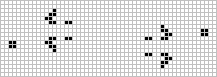
The bi-gun is a double-barreled glider gun that was found by Bill Gosper in the early 1970's.[1] Much like his Gosper glider gun works by colliding two queen bee shuttles together, the bi-gun works by colliding two twin bees shuttles together. Dietrich Leithner discovered that it can be synthesised with 12 gliders.