Bipole: Difference between revisions
Jump to navigation
Jump to search
m Pentadecathlon ID |
m isorule |
||
| Line 16: | Line 16: | ||
|rulemin = B3/S23 | |rulemin = B3/S23 | ||
|rulemax = B35678/S02345678 | |rulemax = B35678/S02345678 | ||
|rulespecial = [[Conway's Game of Life|Conway Life]], [[HighLife]] | |||
|isorulemin = B3c/S2ae3n | |||
|isorulemax = B2ckn34-r5678/S01e2345678 | |||
|synthesis = 5 | |synthesis = 5 | ||
|synthesisRLE = true | |synthesisRLE = true | ||
Revision as of 13:51, 12 January 2019
| Bipole | |||||||||
| View animated image | |||||||||
| View static image | |||||||||
| Pattern type | Oscillator | ||||||||
|---|---|---|---|---|---|---|---|---|---|
| Oscillator type | Muttering moat | ||||||||
| Family | Barberpole | ||||||||
| Number of cells | 8 | ||||||||
| Bounding box | 5 × 5 | ||||||||
| Frequency class | 21.7 | ||||||||
| Period | 2 (mod: 1) | ||||||||
| Heat | 4 | ||||||||
| Volatility | 0.40 | 0.40 | ||||||||
| Kinetic symmetry | Unspecified | ||||||||
| Rotor type | Pole 2 | ||||||||
| Discovered by | Unknown | ||||||||
| Year of discovery | 1970 | ||||||||
| |||||||||
| |||||||||
| |||||||||
| |||||||||
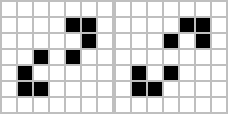

The bipole is the barberpole of length 2 and is thus an oscillator of period 2. It is the smallest possible barberpole.
The bipole is the seventh most common oscillator in Achim Flammenkamp's census, being less common than the clock and pentadecathlon but more common than the quadpole.[1]
See also
References
- ↑ Achim Flammenkamp (September 7, 2004). "Most seen natural occurring ash objects in Game of Life". Retrieved on January 15, 2009.
External links
- Bipole at the Life Lexicon
- 8P2.1 at Heinrich Koenig's Game of Life Object Catalogs
Categories:
- Patterns
- Patterns with Catagolue frequency class 21
- Natural periodic objects
- Oscillators with 8 cells
- Periodic objects with minimum population 8
- Patterns with 8 cells
- Patterns found in 1970
- Patterns that can be constructed with 5 gliders
- Oscillators
- Barberpole variants
- Muttering moats
- Oscillators with period 2
- Oscillators with mod 1
- Oscillators with heat 4
- Oscillators with volatility 0.40
- Oscillators with strict volatility 0.40
- Oscillators with rotor Pole 2
- Patterns with 180-degree rotation symmetry
- Flipping oscillators