P42 glider shuttle: Difference between revisions
Apple Bottom (talk | contribs) sv |
m period-# → period # |
||
| Line 22: | Line 22: | ||
|apgcode = xp42_y58k8y6nfgzxgwo4iq226y033325210g8mwiozw121074w4a96y3g091gpzy1ssy9hj30ggzccc8ka52wow8276wj10c4gf0252zy244252w23y019l91zy21023 | |apgcode = xp42_y58k8y6nfgzxgwo4iq226y033325210g8mwiozw121074w4a96y3g091gpzy1ssy9hj30ggzccc8ka52wow8276wj10c4gf0252zy244252w23y019l91zy21023 | ||
}} | }} | ||
The '''p42 glider shuttle''' is a [[period]] | The '''p42 glider shuttle''' is a [[period]] [[:Category:oscillators with period 42|42]] [[shuttle]] [[oscillator]] discovered by [[Noam Elkies]] in [[:Category:patterns found in 1994|1994]]. It was the first non-trivial period 42 oscillator to be discovered<ref>{{CiteHickersonOscillators|accessdate=July 8, 2010}}</ref> and is based on a period 66 oscillator discovered by [[Robert Wainwright]] in September [[:category:patterns found in 1984|1984]]. It works by using two copies of [[eater 3]] and four copies of [[unix]] to shuttle two [[glider]]s back and forth. By increasing the distance between the two reflectors, oscillators of periods 42 + 24n can be created. [[Dean Hickerson]] found that the distance between the reflectors could be decreased using a custom period 6 oscillator to create a period 18 glider shuttle. In April [[:Category:patterns found in 1992|1992]] Hickerson created another related oscillator by crossing two pairs of gliders using [[rephaser]]s, which allowed the construction of oscillators of periods 246 + 24n. | ||
==Image gallery== | ==Image gallery== | ||
{| | {| | ||
|- | |- | ||
|[[Image:p18glidershuttle.png|framed|left|A p18 glider shuttle using a custom period | |[[Image:p18glidershuttle.png|framed|left|A p18 glider shuttle using a custom period 6 oscillator by Dean Hickerson<br/>{{JavaRLE|p18glidershuttle|brief}}]] | ||
|[[Image:p246glidershuttle.png|framed|left|A related p246 oscillator discovered by Dean Hickerson<br/>{{JavaRLE|p246glidershuttle|brief}}]] | |[[Image:p246glidershuttle.png|framed|left|A related p246 oscillator discovered by Dean Hickerson<br/>{{JavaRLE|p246glidershuttle|brief}}]] | ||
|} | |} | ||
Revision as of 21:37, 15 December 2018
| p42 glider shuttle | |||||||
| View animated image | |||||||
| View static image | |||||||
| Pattern type | Oscillator | ||||||
|---|---|---|---|---|---|---|---|
| Oscillator type | Shuttle | ||||||
| Number of cells | 143 | ||||||
| Bounding box | 32 × 32 | ||||||
| Period | 42 (mod: Unknown) | ||||||
| Heat | 56.1 | ||||||
| Volatility | 0.75 | 0.33 | ||||||
| Kinetic symmetry | Unspecified | ||||||
| Discovered by | Noam Elkies | ||||||
| Year of discovery | 1994 | ||||||
| |||||||
| |||||||
| |||||||

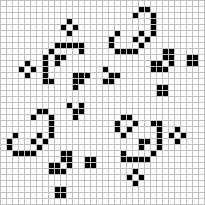
The p42 glider shuttle is a period 42 shuttle oscillator discovered by Noam Elkies in 1994. It was the first non-trivial period 42 oscillator to be discovered[1] and is based on a period 66 oscillator discovered by Robert Wainwright in September 1984. It works by using two copies of eater 3 and four copies of unix to shuttle two gliders back and forth. By increasing the distance between the two reflectors, oscillators of periods 42 + 24n can be created. Dean Hickerson found that the distance between the reflectors could be decreased using a custom period 6 oscillator to create a period 18 glider shuttle. In April 1992 Hickerson created another related oscillator by crossing two pairs of gliders using rephasers, which allowed the construction of oscillators of periods 246 + 24n.
Image gallery
 RLE: here |
 RLE: here |
See also
References
- ↑ Dean Hickerson's oscillator stamp collection. Retrieved on July 8, 2010.
External links
- Patterns
- Oscillators with between 140 and 149 cells
- Periodic objects with minimum population between 140 and 149
- Patterns with between 140 and 149 cells
- Patterns found by Noam Elkies
- Patterns found in 1994
- Oscillators
- Shuttles
- Oscillators with period 42
- Oscillators with heat 56
- Oscillators with volatility 0.75
- Oscillators with strict volatility 0.33
- Patterns with bilateral diagonal symmetry
- Flipping oscillators