Unix: Difference between revisions
Jump to navigation
Jump to search
This doesn't really count as a trivial oscillator since apgsearch would classify them as separate objects |
No edit summary |
||
| Line 33: | Line 33: | ||
==See also== | ==See also== | ||
*[[ | *[[P18 bi-block hassler]] | ||
*[[Unicycle]] | *[[Unicycle]] | ||
Revision as of 14:59, 14 December 2018
| Unix | |||||||||
| View animated image | |||||||||
| View static image | |||||||||
| Pattern type | Oscillator | ||||||||
|---|---|---|---|---|---|---|---|---|---|
| Number of cells | 16 | ||||||||
| Bounding box | 9 × 9 | ||||||||
| Frequency class | 29.3 | ||||||||
| Period | 6 (mod: 6) | ||||||||
| Heat | 11.3 | ||||||||
| Volatility | 0.80 | 0.80 | ||||||||
| Kinetic symmetry | Unspecified | ||||||||
| Discovered by | David Buckingham | ||||||||
| Year of discovery | 1976 | ||||||||
| |||||||||
| |||||||||
| |||||||||
| |||||||||

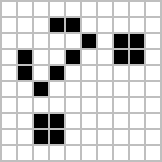
Unix (plural: unices) is a period 6 oscillator that was found by David Buckingham on February 10, 1976. It consists of two blocks eating a long barge and is a useful sparker.[1] Its name derives from the fact that it was for some time the mascot of the Unix lab of the mathematics faculty at the University of Waterloo in Ontario, Canada. With just 16 cells, it is the smallest known period 6 oscillator.[2]
Unix is about the twenty-sixth most common naturally-occurring oscillator in Achim Flammenkamp's census, being about as common as octagon 2.[3] On Catagolue, it is the most common period 6 oscillator and the only non-trivial one to have appeared naturally, as all others consist of period 2 and 3 rotors that do not interact.[4]
See also
References
- ↑ Dean Hickerson's oscillator stamp collection.
- ↑ "Class 2 Objects Catalog". Retrieved on March 14, 2009.
- ↑ Achim Flammenkamp (September 7, 2004). "Most seen natural occurring ash objects in Game of Life". Retrieved on January 15, 2009.
- ↑ Adam P. Goucher. "Statistics". Catagolue. Retrieved on October 27, 2018.
External links
- Unix at the Life Lexicon
- Unix at Adam P. Goucher's Catagolue
- 16P6.1 at Heinrich Koenig's Game of Life Object Catalogs
Categories:
- Patterns
- Patterns with Catagolue frequency class 29
- Natural periodic objects
- Oscillators with 16 cells
- Periodic objects with minimum population 16
- Patterns with 16 cells
- Patterns found by David Buckingham
- Patterns found in 1976
- Patterns that can be constructed with 6 gliders
- Oscillators
- Oscillators with period 6
- Oscillators with mod 6
- Oscillators with heat 11
- Oscillators with volatility 0.80
- Oscillators with strict volatility 0.80
- Sparking oscillators
- Patterns with bilateral diagonal symmetry