Kickback reaction: Difference between revisions
Jump to navigation
Jump to search
m rle=true, added note on 180-degree kickbacks |
m minor fixes |
||
| Line 7: | Line 7: | ||
|rle = true | |rle = true | ||
}} | }} | ||
A '''kickback reaction''' is a collision of two gliders resulting in a single glider travelling in the opposite direction to one of the original gliders. This is important in the proof of the existence of a [[universal constructor]], and in Bill Gosper's [[total aperiodic]], as well as a number of other constructions. | |||
Besides the 90-degree collision shown here, one other [[two-glider collision]] with gliders meeting at 180 degrees also produces a clean output glider, and may also be called a "kickback reaction". This reaction is occasionally useful in glider syntheses. However, it is rarely used in signal circuitry or in self-supporting patterns like the [[Caterpillar]] or [[Centipede]], because 90-degree collisions are generally much easier to arrange. | |||
Revision as of 18:41, 23 February 2018
| Kickback reaction | |||||
| |||||
| View static image | |||||
| Pattern type | Miscellaneous | ||||
|---|---|---|---|---|---|
| Number of cells | 10 | ||||
| Bounding box | 8 × 5 | ||||
| Static symmetry | Unspecified | ||||
| Discovered by | Unknown | ||||
| Year of discovery | Unknown | ||||
| |||||

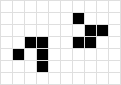
A kickback reaction is a collision of two gliders resulting in a single glider travelling in the opposite direction to one of the original gliders. This is important in the proof of the existence of a universal constructor, and in Bill Gosper's total aperiodic, as well as a number of other constructions.
Besides the 90-degree collision shown here, one other two-glider collision with gliders meeting at 180 degrees also produces a clean output glider, and may also be called a "kickback reaction". This reaction is occasionally useful in glider syntheses. However, it is rarely used in signal circuitry or in self-supporting patterns like the Caterpillar or Centipede, because 90-degree collisions are generally much easier to arrange.