Kickback reaction: Difference between revisions
Jump to navigation
Jump to search
No edit summary |
m rle=true, added note on 180-degree kickbacks |
||
| Line 5: | Line 5: | ||
|bx = 8 | |bx = 8 | ||
|by = 5 | |by = 5 | ||
| | |rle = true | ||
}} | }} | ||
The '''Kickback reaction''' is a collision of two gliders resulting in a single glider travelling in the opposite direction to one of the original gliders. This is important in the proof of the existence of a [[universal constructor]], and in Bill Gosper's [[total aperiodic]], as well as a number of other constructions. | The '''Kickback reaction''' is a collision of two gliders resulting in a single glider travelling in the opposite direction to one of the original gliders. This is important in the proof of the existence of a [[universal constructor]], and in Bill Gosper's [[total aperiodic]], as well as a number of other constructions. | ||
One other two-glider collision, with gliders meeting at 180 degrees, also produces a clean output glider, and may also be called a "kickback reaction". This reaction is occasionally useful in glider syntheses. However, it is rarely used in signal circuitry or in self-supporting patterns like the [[Caterpillar]] or [[Centipede]], because 90-degree collisions are generally much easier to arrange. | |||
Revision as of 19:59, 19 October 2016
| Kickback reaction | |||||
| |||||
| View static image | |||||
| Pattern type | Miscellaneous | ||||
|---|---|---|---|---|---|
| Number of cells | 10 | ||||
| Bounding box | 8 × 5 | ||||
| Static symmetry | Unspecified | ||||
| Discovered by | Unknown | ||||
| Year of discovery | Unknown | ||||
| |||||

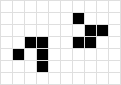
The Kickback reaction is a collision of two gliders resulting in a single glider travelling in the opposite direction to one of the original gliders. This is important in the proof of the existence of a universal constructor, and in Bill Gosper's total aperiodic, as well as a number of other constructions.
One other two-glider collision, with gliders meeting at 180 degrees, also produces a clean output glider, and may also be called a "kickback reaction". This reaction is occasionally useful in glider syntheses. However, it is rarely used in signal circuitry or in self-supporting patterns like the Caterpillar or Centipede, because 90-degree collisions are generally much easier to arrange.