Figure eight: Difference between revisions
Jump to navigation
Jump to search
Picture/cell number changes |
m Wording |
||
| Line 4: | Line 4: | ||
==Image gallery== | ==Image gallery== | ||
<gallery> | <gallery> | ||
Image:figureeightorigin.png|One of the phases of the oscillator, which led to it being | Image:figureeightorigin.png|One of the phases of the oscillator, which led to it being named the Figure Eight. | ||
</gallery> | </gallery> | ||
Revision as of 23:58, 5 February 2009
| Figure eight | |||||||
| View animated image | |||||||
| View static image | |||||||
| Pattern type | Oscillator | ||||||
|---|---|---|---|---|---|---|---|
| Number of cells | 12 | ||||||
| Period | 8 (mod: Unknown) | ||||||
| Heat | Unknown | ||||||
| Volatility | Unknown | Unknown | ||||||
| Kinetic symmetry | Unspecified | ||||||
| Discovered by | Simon Norton | ||||||
| Year of discovery | 1970 | ||||||
| |||||||
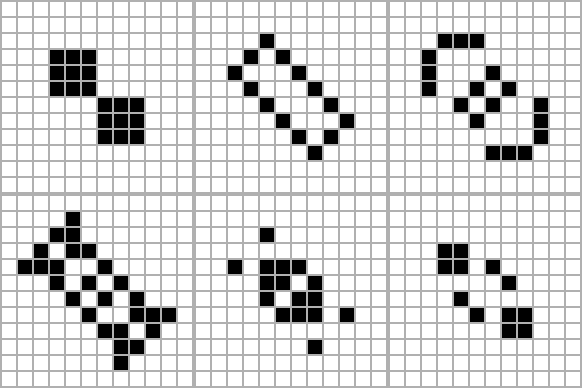
Figure eight is a period 8 oscillator found by Simon Norton in 1970. It is the tenth most common naturally-occurring oscillator, being less common than the great on-off but more common than the spark coil.[1]
Image gallery
-
 One of the phases of the oscillator, which led to it being named the Figure Eight.


See also
References
- ↑ Achim Flammenkamp (September 7, 2004). "Most seen natural occurring ash objects in Game of Life". Retrieved on January 15, 2009.
External links
Figure eight at the Life Lexicon