Worker bee: Difference between revisions
Jump to navigation
Jump to search
Deleted User (talk | contribs) No edit summary |
No edit summary |
||
| Line 7: | Line 7: | ||
==External links== | ==External links== | ||
{{LinkLexicon|lex_w.htm#workerbee}} | {{LinkLexicon|lex_w.htm#workerbee}} | ||
{{Symmetry|orthogonal4}} | |||
Revision as of 07:32, 1 April 2016
| Worker bee | |||||||||
| View animated image | |||||||||
| View static image | |||||||||
| Pattern type | Oscillator | ||||||||
|---|---|---|---|---|---|---|---|---|---|
| Number of cells | 34 | ||||||||
| Bounding box | 16 × 11 | ||||||||
| Period | 9 (mod: Unknown) | ||||||||
| Heat | 15.6 | ||||||||
| Volatility | 0.66 | Unknown | ||||||||
| Kinetic symmetry | Unspecified | ||||||||
| Discovered by | David Buckingham | ||||||||
| Year of discovery | 1972 | ||||||||
| |||||||||
| |||||||||
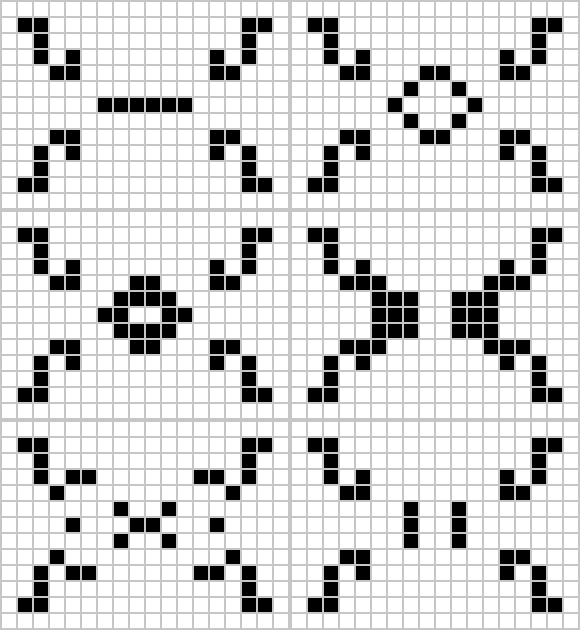
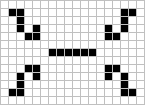
Worker bee (or lonely bee[1]) is a period 9 oscillator and was found by David Buckingham in 1972. Unlike the similar snacker, worker bee produces no accessible sparks(note the generated monominos), and is thus not considered to be very important. Like the snacker, the worker bee is extensible - it is, in fact, a finite version of the infinite oscillator which consists of six on cells and two off cells alternating along a line.
References
- ↑ Mark D. Niemiec. "Life Objects Sorted by Name (L)". Retrieved on May 1, 2009.
External links
- Worker bee at the Life Lexicon
Categories:
- Patterns
- Oscillators with 34 cells
- Periodic objects with minimum population 34
- Patterns with 34 cells
- Patterns found by David Buckingham
- Patterns found in 1972
- Patterns that can be constructed with 19 gliders
- Oscillators
- Oscillators with period 9
- Oscillators with heat 15
- Oscillators with volatility 0.66
- Patterns with rectangular orthogonal symmetry