Mold on fumarole: Difference between revisions
Jump to navigation
Jump to search
No edit summary |
No edit summary |
||
| Line 29: | Line 29: | ||
Despite being composed of two oscillators of smaller period ({{period|4|brief}} and {{period|5|brief}} respectively), it is considered non-trivial because it has a single cell that is alive in [[generation]] 1 and is dead in its other 19 [[phase]]s. | Despite being composed of two oscillators of smaller period ({{period|4|brief}} and {{period|5|brief}} respectively), it is considered non-trivial because it has a single cell that is alive in [[generation]] 1 and is dead in its other 19 [[phase]]s. | ||
== | == Gallery == | ||
{| | {| | ||
|[[File:Moldonfumarole gen1.png|thumb|left|Generation 1 reveals the single cell with period 20 (in green)]] | |||
|[[ | |||
|} | |} | ||
==References== | == References == | ||
<references /> | <references /> | ||
Latest revision as of 20:09, 7 August 2024
| Mold on fumarole | |||||||||
| View animated image | |||||||||
| View static image | |||||||||
| Pattern type | Oscillator | ||||||||
|---|---|---|---|---|---|---|---|---|---|
| Number of cells | 30 | ||||||||
| Bounding box | 9 × 14 | ||||||||
| Period | 20 (mod: 20) | ||||||||
| Heat | 19.9 | ||||||||
| Volatility | 0.70 | 0.02 | ||||||||
| Kinetic symmetry | n | ||||||||
| Discovered by | Unknown | ||||||||
| Year of discovery | Unknown | ||||||||
| |||||||||
| |||||||||
| |||||||||
| |||||||||
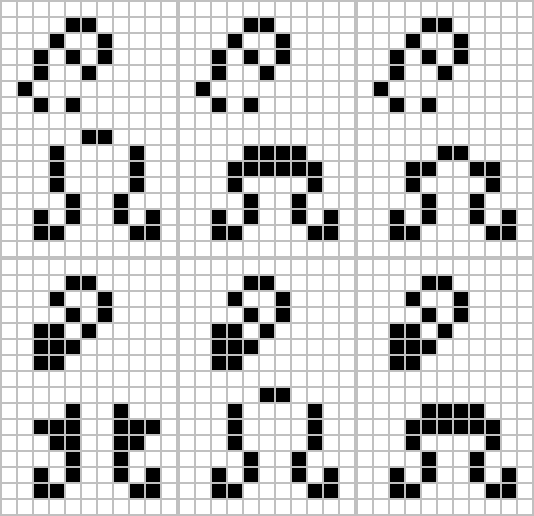
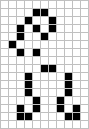
Mold on fumarole is a period-20 oscillator composed of a mold and a fumarole. In terms of its minimum population of 30 cells, it is the smallest known period 20 oscillator.[1]
Despite being composed of two oscillators of smaller period (4 and 5 respectively), it is considered non-trivial because it has a single cell that is alive in generation 1 and is dead in its other 19 phases.
Gallery
 |
References
- ↑ Jason Summers' all-osc pattern collection. Retrieved on April 17, 2009.
External links
- 30P20.1 at Heinrich Koenig's Game of Life Object Catalogs
Categories:
- Patterns
- Oscillators with 30 cells
- Periodic objects with minimum population 30
- Patterns with 30 cells
- Patterns that can be constructed with 11 gliders
- Oscillators
- Oscillators with period 20
- Oscillators with mod 20
- Oscillators with heat 19
- Oscillators with volatility 0.70
- Oscillators with strict volatility 0.02
- Oscillators with n symmetry
- Least-common-multiple oscillators