Given the number of articles that talk about prime numbers, it does seem reasonable to expect a dedicated article for prime numbers and their subclasses, at some point in future, sooner or later. Anyway that would be better than inline external links. Maybe factorials/Fibonacci numbers deserve articles as well
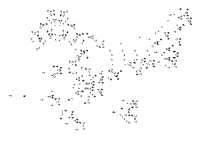
}}'''Primer''' is a [[pattern]] that was constructed by [[Dean Hickerson]] on November 1, {{year|1991}} that produces a stream of [[lightweight spaceship]]s representing [[Prime number|prime numbers]]. N is prime if and only if a lightweight spaceship escapes to the left of the [[pentadecathlon]] at the bottom-left corner of the pattern at [[generation]] 120N+100.<ref>PRIMES.LIF from [[Alan Hensel]]'s [http://www.ibiblio.org/lifepatterns/ lifep.zip pattern collection]. Accessed on July 28, 2009.</ref><ref>four-primers.rle.gz from [[Golly]]'s built-in pattern catalogue. Accessed on July 28, 2009.</ref> It was the first known pattern created that computes prime numbers, though others have since been constructed based on the same ideas.<ref name="post6330"></ref>
|hideimg = true
}}
'''Primer''' is a [[pattern]] that was constructed by [[Dean Hickerson]] on November 1, {{year|1991}} that produces a stream of [[lightweight spaceship]]s representing [[Prime number|prime numbers]]. N is prime if and only if a lightweight spaceship escapes to the left of the [[pentadecathlon]] at the bottom-left corner of the pattern at [[generation]] {{nowrap|120 N + 100}}.<ref>{{filename|PRIMES.LIF}} from [[Alan Hensel]]'s [http://www.ibiblio.org/lifepatterns/ {{filename|lifep.zip}} pattern collection]. Accessed on July 28, 2009.</ref><ref>{{CiteGollyPatternCollection|four-primers.rle.gz|accessdate=July 28, 2009}}</ref> It was the first known pattern created that computes prime numbers, though others have since been constructed based on the same ideas.<ref name="post6330" />
It works by using [[glider]]s to emulate a prime number sieve<ref>Wikipedia, [https://en.wikipedia.org/wiki/Sieve_of_Eratosthenes Sieve of Eratosthenes]</ref>. Lightweight spaceships that move westward are deleted by gliders that represent positive integers if the lightweight spaceship represents a multiple of that number.
It works by using [[glider]]s to emulate a prime number sieve<ref>Wikipedia, [https://en.wikipedia.org/wiki/Sieve_of_Eratosthenes Sieve of Eratosthenes]</ref>. Lightweight spaceships that move westward are deleted by gliders that represent positive integers if the lightweight spaceship represents a multiple of that number.
Primer is a pattern that was constructed by Dean Hickerson on November 1, 1991 that produces a stream of lightweight spaceships representing prime numbers. N is prime if and only if a lightweight spaceship escapes to the left of the pentadecathlon at the bottom-left corner of the pattern at generation120 N + 100.[1][2] It was the first known pattern created that computes prime numbers, though others have since been constructed based on the same ideas.[3]
It works by using gliders to emulate a prime number sieve[4]. Lightweight spaceships that move westward are deleted by gliders that represent positive integers if the lightweight spaceship represents a multiple of that number.