Pinwheel: Difference between revisions
Jump to navigation
Jump to search
m update synth cost |
m update synth cost |
||
| Line 19: | Line 19: | ||
|isorulemin = B3ik/S2ik3aeinr | |isorulemin = B3ik/S2ik3aeinr | ||
|isorulemax = B2in34-intw5aceiy678/S01e234-n5678 | |isorulemax = B2in34-intw5aceiy678/S01e234-n5678 | ||
|synthesis = | |synthesis = 188 | ||
|synthesis2 | |synthesis2 = 112 | ||
|synthesisRLE = true | |synthesisRLE = true | ||
|plaintext = true | |plaintext = true | ||
Revision as of 03:25, 7 January 2023
| Pinwheel | |||||||||||||||
| View animated image | |||||||||||||||
| View static image | |||||||||||||||
| Pattern type | Oscillator | ||||||||||||||
|---|---|---|---|---|---|---|---|---|---|---|---|---|---|---|---|
| Oscillator type | Billiard table | ||||||||||||||
| Family | Pinwheel | ||||||||||||||
| Number of cells | 35 | ||||||||||||||
| Bounding box | 12 × 12 | ||||||||||||||
| Period | 4 (mod: 1) | ||||||||||||||
| Heat | 4.0 | ||||||||||||||
| Volatility | 0.20 | 0.20 | ||||||||||||||
| Kinetic symmetry | Unspecified | ||||||||||||||
| Discovered by | Simon Norton | ||||||||||||||
| Year of discovery | 1970 | ||||||||||||||
| |||||||||||||||
| |||||||||||||||
| |||||||||||||||
| |||||||||||||||

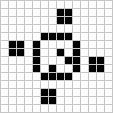
Pinwheel (or Catherine wheel[1]) is a period-4 oscillator found by Simon Norton in April 1970.[2] It is a billiard table configuration and possibly the first period 4 oscillator discovered. Later, another billiard table clock 2 was found, which has the same stator as pinwheel.
On April 22, 2016, Martin Grant provided a glider synthesis for this oscillator. Using the same precursor, the two routes to pinwheel and clock 2 diverge in the middle.[3]
See also
References
- ↑ "Catherine wheel". The Life Lexicon. Stephen Silver. Retrieved on December 3, 2018.
- ↑ Dean Hickerson's oscillator stamp collection. Retrieved on March 14, 2020.
- ↑ Martin Grant (April 22, 2016). Re: Synthesising Oscillators (discussion thread) at the ConwayLife.com forums
External links
- Pinwheel at the Life Lexicon
- 35P4.10 at Heinrich Koenig's Game of Life Object Catalogs
Categories:
- Patterns
- Oscillators with 35 cells
- Periodic objects with minimum population 35
- Patterns with 35 cells
- Patterns found by Simon Norton
- Patterns found in 1970
- Patterns that can be constructed with between 100 and 199 gliders
- Oscillators
- Pinwheel variants
- Billiard tables
- Oscillators with period 4
- Oscillators with mod 1
- Oscillators with heat 4
- Oscillators with volatility 0.20
- Oscillators with strict volatility 0.20
- Non-flipping oscillators that turn 90 degrees