Pulsar Pixel Display: Difference between revisions
Jump to navigation
Jump to search
i'll take care of it |
Names for specific patterns should not be in category:glossary |
||
| Line 1: | Line 1: | ||
{{Pattern | {{Pattern | ||
|name = Pulsar Pixel Display | |name = Pulsar Pixel Display | ||
| Line 13: | Line 12: | ||
|rle = true | |rle = true | ||
|mc = true | |mc = true | ||
}} | }}{{stub}} | ||
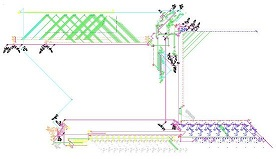
The '''Pulsar Pixel Display''' ('''PPD''') is a large-scale raster line display device completed by [[Mark Walsh]] in August {{year|2011}},<ref name="post4902" /> where [[pulsar]]s form the individual pixels in an otherwise empty grid. The published sample pattern displays and erases eight 7×5-pixel characters on each of two lines of text. | The '''Pulsar Pixel Display''' ('''PPD''') is a large-scale raster line display device completed by [[Mark Walsh]] in August {{year|2011}},<ref name="post4902" /> where [[pulsar]]s form the individual pixels in an otherwise empty grid. The published sample pattern displays and erases eight 7×5-pixel characters on each of two lines of text. | ||
Revision as of 12:17, 23 December 2022
| Pulsar Pixel Display | |||||||
| |||||||
| View static image | |||||||
| Pattern type | Miscellaneous | ||||||
|---|---|---|---|---|---|---|---|
| Number of cells | 118753 | ||||||
| Bounding box | 7170 × 3935 | ||||||
| Static symmetry | Unspecified | ||||||
| Discovered by | Mark Walsh | ||||||
| Year of discovery | 2011 | ||||||
| |||||||
| |||||||


|
This article is a stub. You can help LifeWiki by expanding it. |
The Pulsar Pixel Display (PPD) is a large-scale raster line display device completed by Mark Walsh in August 2011,[1] where pulsars form the individual pixels in an otherwise empty grid. The published sample pattern displays and erases eight 7×5-pixel characters on each of two lines of text.
References
- ↑ Mark Walsh (August 3, 2011). Re: triller's p30 thread (discussion thread) at the ConwayLife.com forums
External links
- Pulsar Pixel Display at the Life Lexicon