Lightweight spaceship: Difference between revisions
No edit summary |
→Construction: failed to check correctness |
||
| Line 46: | Line 46: | ||
{{EmbedViewer | {{EmbedViewer | ||
|rle = x = | |rle = x = 78, y = 45, rule = B3/S23 | ||
76bo$75bo$75b3o20$58bobo$59b2o8bobo$59bo9b2o$70bo2$12bo$11bo$o10b3o$b | |||
2o$2o$19bo18bo$20bo15bobo$18b3o16b2o2$53bo$32bo19b2o$12b2o17b2o19bobo$ | |||
11b2o18bobo$13bo$41b3o$22b3o18bo$24bo17bo$23bo! | |||
|viewerconfig = #C [[ ZOOM 8 WIDTH | |viewerconfig = #C [[ ZOOM 8 WIDTH 800 HEIGHT 400 THEME Book AUTOSTART GPS 12 T 0 PAUSE 1 T 12 PAUSE 7 T 75 PAUSE 1 LOOP 76 ]] | ||
|position = center | |position = center | ||
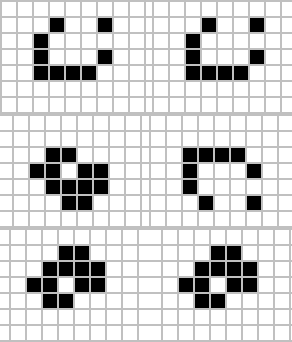
|caption = | |caption = Four 3G syntheses for the LWSS | ||
|style = width:300px; | |style = width:300px; | ||
}} | }} | ||
Revision as of 00:01, 10 November 2022
| Lightweight spaceship | |||||||||
| View animated image | |||||||||
| View static image | |||||||||
| Pattern type | Spaceship | ||||||||
|---|---|---|---|---|---|---|---|---|---|
| Family | XWSS | ||||||||
| Number of cells | 9 | ||||||||
| Bounding box | 5 × 4 | ||||||||
| Frequency class | 11.2 | ||||||||
| Direction | Orthogonal | ||||||||
| Period | 4 (mod: 2) | ||||||||
| Speed | c/2 | 2c/4 | ||||||||
| Heat | 11 | ||||||||
| Kinetic symmetry | Unspecified | ||||||||
| Discovered by | John Conway | ||||||||
| Year of discovery | 1970 | ||||||||
| |||||||||
| |||||||||
| |||||||||
| |||||||||

The lightweight spaceship (commonly abbreviated to LWSS) or (rarely) small fish[1] is the smallest orthogonal spaceship, and the second most common spaceship after the glider. It moves at speed c/2 and has period 4 (and is therefore often referred to as 2c/4). It was found by John Conway in 1970.
Tagalong
In April 1992, David Bell found a tagalong for two lightweight spaceships (or two middleweight spaceships or two heavyweight spaceships). It can be extended indefinitely by attaching it to the back of itself. Interestingly, a hivenudger with symmetric rear (that is, both rear spaceships being of same "weight") can pull this tagalong.
| Tagalong for two lightweight spaceships (click above to open LifeViewer) RLE: here Plaintext: here |
Construction
| Four 3G syntheses for the LWSS (click above to open LifeViewer) |
A number of different ways to construct a LWSS can be found in Mark Niemiec's glider synthesis database;[2] above are shown three-glider syntheses.
A three-object one-glider seed for the lightweight spaceship, consisting of two blocks and a beehive, is used in the pattern Patterns/Life/Breeders/switch-engine-breeder-MR.rle included in Golly's pattern collection. The seed constellation itself can be constructed with four gliders,[3] leading to a way of constructing the LWSS using 5 gliders.
A different one-glider seed that fits inside a 12 × 12 square can be found in the octohash database;[4] it is a constellation of a blinker and an eater 1, itself constructible with four gliders.[5] There are 60 matches in the octo3obj database which are clean one-glider seeds for the LWSS.[6]
|
|
Occurrence
- See also: List of common spaceships
Random soups investigated by Achim Flammenkamp emitted one LWSS for approximately every 615 gliders.[7] The LWSS is also the eighteenth most common object on Adam P. Goucher's Catagolue.[8]
There are 733 collisions in the octohash database, 6591 collisions in the octo3obj database, and 1010 three-glider collisions in the octo3g database with at least one escaping LWSS.
See also
- Fake xWSS
- Middleweight spaceship, Heavyweight spaceship, LWSS on MWSS 1, LWSS on HWSS 1
- Lightweight emulator
- Toaster
- Infinite LWSS hotel
- G-to-LWSS
References
- ↑ "Small fish". The Life Lexicon. Stephen Silver. Retrieved on June 10, 2009.
- ↑ The 1 nine-bit spaceship at Mark D. Niemiec's Life Page (download pattern file: ss/9lw.rle)
- ↑ xs14_696y6oozy5cc at Adam P. Goucher's Catagolue (pseudo-object)
- ↑ Repository on GitHub
- ↑ xp2_354cxs at Adam P. Goucher's Catagolue (pseudo-object)
- ↑ Dave Greene (October 21, 2022). Re: Octohash fingerprints (discussion thread) at the ConwayLife.com forums
- ↑ "Spontaneous appeared Spaceships out of Random Dust". Achim Flammenkamp (December 9, 1995). Retrieved on August 18, 2011.
- ↑ Adam P. Goucher. "Statistics". Catagolue. Retrieved on June 24, 2016.
External links
- LWSS at the Life Lexicon
- Lightweight spaceship at Adam P. Goucher's Catagolue
- Lightweight Spaceship at Heinrich Koenig's Game of Life Object Catalogs
- Life (B3/S23) at David Eppstein's Glider Database
- LWSS on LWSS at Adam P. Goucher's Catagolue (pseudo-object)
- xWSS Tagalong at Adam P. Goucher's Catagolue
- Patterns
- Patterns with Catagolue frequency class 11
- Natural periodic objects
- Spaceships with 9 cells
- Periodic objects with minimum population 9
- Patterns with 9 cells
- Patterns found by John Conway
- Patterns found in 1970
- Patterns that can be constructed with 3 gliders
- Spaceships
- Spaceships with period 4
- Orthogonal spaceships
- Spaceships with speed c/2
- Spaceships with unsimplified speed 2c/4
- Spaceships with heat 11
- XWSS variants
- Spaceships with mod 2
- Polyominoes
- Glide symmetric spaceships