OCA:Flock: Difference between revisions
| Line 73: | Line 73: | ||
{| style="margin-left: auto; margin-right: auto;" | {| style="margin-left: auto; margin-right: auto;" | ||
|- | |- | ||
| | | {{EmbedViewer | ||
|rle = x = 50, y = 5, rule = B3/S12 | |||
15b2o20b2o$7bo7bobo8bo6b2o3bo4b2obo$2o5bobo16bo6bo2b2o7b2o2bo$o7bo8bo | |||
bo4bobobo5bo2bo6bobo2bo$b2o6b2o7b2o4bo2b2o6b2o10bo! | |||
|imgname = Flockp2 | |||
|position = center | |||
|caption = Small period-2 oscillators. | |||
}} | |||
|- | |- | ||
| [[File:Flockp4.png|frame|center|Small period-4 oscillators.]] | | [[File:Flockp4.png|frame|center|Small period-4 oscillators.]] | ||
| Line 81: | Line 88: | ||
2b2o$o2bo$3bo$obo4bo$bo4bobo$5bo$5bo2bo$5b2o! | 2b2o$o2bo$3bo$obo4bo$bo4bobo$5bo$5bo2bo$5b2o! | ||
|position = center | |position = center | ||
|caption = Period-7 oscillator | |caption = Period-7 oscillator. | ||
|apgcode = xp7_c9852zx4a193/b3s12 | |apgcode = xp7_c9852zx4a193/b3s12 | ||
}} | }} | ||
Revision as of 06:03, 30 August 2022
| Flock | |
| View static image | |
| Rulestring | 12/3 B3/S12 |
|---|---|
| Rule integer | 3080 |
| Character | Chaotic |
| Black/white reversal | B0123458/S01234678 |

|
This article is a stub. You can help LifeWiki by expanding it. |
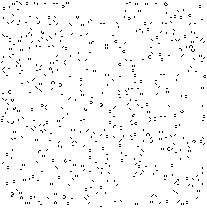
Flock is a cellular automaton with the rulestring B3/S12. It differs very strongly from Conway's Game of Life and similar automata. It is the sixth most searched rule on Catagolue in terms of the total number of objects censused as of December 2018.
Patterns
Due to the missing S3 survival condition and addition of the S1 survival condition, almost no patterns from Life are compatible with Flock and vice versa. Random starting soups rapidly degenerate into dominoes and still duoplets. Tub, beehive, loaf and mango still work as expected, as do the infinite family of lakes (including small lake and its extended derivatives).
The rule, however, does share many features with rules such as 2×2 and Goat Flock.
There are small p2 oscillators which resemble the ship, long ship and very long ship when played, one of which looks like a bipole in one phase. This family of oscillators does not appear to be extendable.
Familiar fours
Despite the vastly different behaviour of patterns, some patterns can still settle naturally into familiar fours and related constellations. One, for example, is called flock, a constellation of four duoplets, which evolves from a 3x3 square of cells as in the traffic light sequence.
|
|
Another familiar four is known as radiator, composed of four dominoes.
|
|
Spaceships
Both orthogonal and diagonal spaceships exist in this rule; of these, only one has occurred naturally yet. David Eppstein lists two orthogonal period-4 c/4 ships and a diagonal period-8 c/4 ship; additionally, Josh Ball found a c/5 orthogonal ship.
 |
 |
 |
Oscillators
Many oscillators occur naturally in this rule. There are many extremely common p2 and p4 oscillators. p3 oscillators are somewhat rare but have been observed.
Oscillators with higher periods have been known to occur naturally. One of the most common of these is the Tetris shuttle, consisting of a tetromino (which is a beehive grandparent in normal Life) being hassled by two dominoes. There is also a p9 which is a bit less common, along with one occurrence of a p7.
| ||
 | ||
| ||
 |


External links
- Flock at Adam P. Goucher's Catagolue
- Flock at David Eppstein's Glider Database
- B3/S12 (discussion thread) at the ConwayLife.com forums