Boat-bit: Difference between revisions
If you find it non-notable, you may undo it. |
discoveryear = 1971; Lifeline Volume 3 mentions the reaction with a fishhook |
||
| Line 6: | Line 6: | ||
|bx = 8 | |bx = 8 | ||
|by = 3 | |by = 3 | ||
|discoveryear = 1971 <!--Lifeline Volume 3 with a fishhook instead of a snake--> | |||
|rulemin = B3/S23 | |rulemin = B3/S23 | ||
|rulemax = B378/S2378 | |rulemax = B378/S2378 | ||
Revision as of 13:10, 12 July 2022
| Boat-bit | |||||||||
| View static image | |||||||||
| Pattern type | Memory cell | ||||||||
|---|---|---|---|---|---|---|---|---|---|
| Number of cells | 11 | ||||||||
| Bounding box | 8 × 3 | ||||||||
| Static symmetry | Unspecified | ||||||||
| Discovered by | Unknown | ||||||||
| Year of discovery | 1971 | ||||||||
| |||||||||
| |||||||||
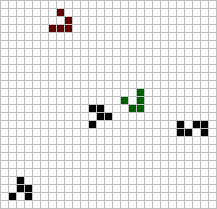
A boat-bit is a binary digit represented by the presence or absence of a boat next to a snake (or other suitable object, such as an aircraft carrier or eater 1). The bit can be toggled by a glider travelling along a certain path. Such an object is sometimes called a snake-bit, although that name is less sensible because the snake can easily be replaced by other objects.[1] A correctly timed glider on a crossing path can detect whether the transition was from 1 to 0 (in which case the crossing glider is deleted) or from 0 to 1 (in which case it passes unharmed). Three gliders therefore suffice for a non-destructive read.
The mechanisms involved in reading and writing a boat-bit are shown in the image in the infobox. The bit as shown in is the 0 state, with no boat present. It is about to be set to 1 by the incoming green glider, and then switched back to 0 again by the red glider. The first crossing glider will survive, but the second will be destroyed.
David Bell found a method of reading the bit while setting it to 0 in January 1997. It works by firing a middleweight spaceship at the boat-bit. If it is already 0 then the middleweight spaceship passes unharmed, but if it is 1 then the boat and the middleweight spaceship are destroyed and, with the help of an eater 1, converted into a glider that travels back along exactly the same path that is used by the gliders that toggle the boat-bit:
| (click above to open LifeViewer) RLE: here Plaintext: here |
Other patterns that can be used to perform the boat-bit reaction include beacon (in its dense phase), the barberpoles (in one of the phases, though uncommon), table (if stabilised), carrier, and eater 1.
References
- ↑ "Snake-bit". The Life Lexicon. Stephen Silver. Retrieved on June 3, 2009.
External links
- Boat-bit at the Life Lexicon