Figure eight: Difference between revisions
merging caterer on figure eight to here |
m tweak |
||
| Line 44: | Line 44: | ||
|position = center | |position = center | ||
|viewerconfig = #C [[ GPS 12 THUMBSIZE 2 ]] | |viewerconfig = #C [[ GPS 12 THUMBSIZE 2 ]] | ||
|caption = [[Caterer]] on figure eight, the smallest known p24 oscillator by population | |caption = [[Caterer]] on figure eight, the smallest<br/>known p24 oscillator by population<br/> | ||
}} | }} | ||
|} | |} | ||
Revision as of 17:47, 21 January 2022
| Figure eight | |||||||||
| View animated image | |||||||||
| View static image | |||||||||
| Pattern type | Oscillator | ||||||||
|---|---|---|---|---|---|---|---|---|---|
| Number of cells | 12 | ||||||||
| Bounding box | 10 × 10 | ||||||||
| Frequency class | 23.4 | ||||||||
| Period | 8 (mod: 8) | ||||||||
| Heat | 16.5 | ||||||||
| Volatility | 1.00 | 1.00 | ||||||||
| Kinetic symmetry | Unspecified | ||||||||
| Discovered by | Simon Norton | ||||||||
| Year of discovery | 1970 | ||||||||
| |||||||||
| |||||||||
| |||||||||
| |||||||||
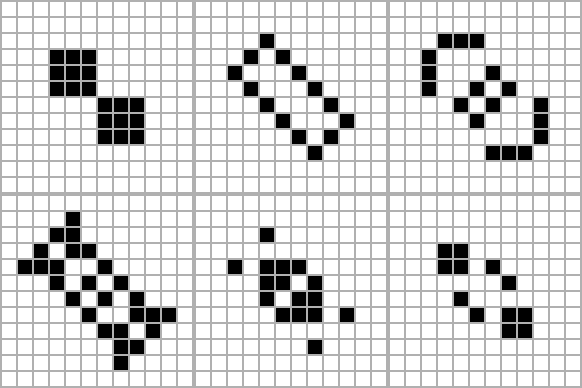
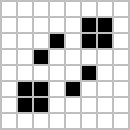
Figure eight (or less frequently, big beacon[1] or lemniscate) is a period-8 oscillator found by Simon Norton in 1970.[2] With 12 cells in its initial phase, it is the smallest known period 8 oscillator, behind blocker at 15 cells. It is known that no period 8 oscillators exist with 10 or fewer cells.[3]
Producing a domino spark, it is useful for constructing larger oscillators with period that is a multiple of eight. For example, it appears in tumbling T-tetson (period 8), sailboat (period 16), caterer on figure eight (the smallest period 24 oscillator), and figure eight on Jason's p22 (period 88). It is also the key component in the p8 bouncer.
Figure eight is the tenth most common naturally-occurring oscillator in Achim Flammenkamp's census, being less common than the great on-off but more common than the spark coil.[4] On Catagolue, it is the most common period 8 oscillator, being more common than blocker.[5]
All strict still lifes with a population of 23 or fewer cells, all oscillators with 16 or fewer cells, and all spaceships with 35 or fewer cells are known to be glider-constructible. A glider synthesis of this object can be found in the infobox to the right.
Gallery
 |
|
See also
References
- ↑ "Big beacon". The Life Lexicon. Stephen Silver. Retrieved on June 14, 2011.
- ↑ Dean Hickerson's oscillator stamp collection. Retrieved on March 14, 2020.
- ↑ Mark Niemiec (1998). "Life Period-8 Oscillators". Retrieved on February 5, 2009.
- ↑ Achim Flammenkamp (September 7, 2004). "Most seen natural occurring ash objects in Game of Life". Retrieved on January 15, 2009.
- ↑ Adam P. Goucher. "Statistics". Catagolue. Retrieved on October 27, 2018.
External links
- Figure-8 at the Life Lexicon
- 12P8.1 at Heinrich Koenig's Game of Life Object Catalogs
- Patterns
- Patterns with Catagolue frequency class 23
- Natural periodic objects
- Oscillators with 12 cells
- Periodic objects with minimum population 12
- Patterns with 12 cells
- Patterns found by Simon Norton
- Patterns found in 1970
- Patterns that can be constructed with 4 gliders
- Oscillators
- Oscillators with period 8
- Oscillators with mod 8
- Oscillators with heat 16
- Oscillators with volatility 1.00
- Oscillators with strict volatility 1.00
- Patterns with rectangular diagonal symmetry
- Sparkers
- Sparkers with period 8
- Domino sparkers
- Moderate sparkers