Dove: Difference between revisions
Jump to navigation
Jump to search
No edit summary |
No edit summary |
||
| Line 16: | Line 16: | ||
The [[stairstep hexomino]], if half of it is deleted after the two halves initially separate, forms a dove in 42 generations. The dove forms a lumps of muck sequence (although through a different predecessor) in what is effectively 20 generations. This is the basis of the [[p124 lumps of muck hassler]]; 2×(42+20) = 124. | The [[stairstep hexomino]], if half of it is deleted after the two halves initially separate, forms a dove in 42 generations. The dove forms a lumps of muck sequence (although through a different predecessor) in what is effectively 20 generations. This is the basis of the [[p124 lumps of muck hassler]]; 2×(42+20) = 124. | ||
== As a still life component == | |||
As mentioned previously, it can act as an induction coil. Two doves suffice to make a still life, with five possible isomers: | |||
* [[Cis-mirrored dove]] | |||
* [[Trans-mirrored dove]] | |||
* [[Shift-mirrored dove]] | |||
* [[Cis-rotated dove]] | |||
* [[Trans-rotated dove]] | |||
A sixth still life exists in which physical connection between both dove exists: | |||
* [[Dove bridge dove]] | |||
== Gallery == | == Gallery == | ||
| Line 27: | Line 38: | ||
== See also == | == See also == | ||
* [[Bun]] | |||
* [[Bun | * [[Wing]] | ||
* [[Wing | |||
== External links == | == External links == | ||
{{LinkLexicon|lex_d.htm#dove}} | {{LinkLexicon|lex_d.htm#dove}} | ||
Revision as of 20:16, 26 December 2021
| Dove | |||||||
| View static image | |||||||
| Pattern type | Induction coil | ||||||
|---|---|---|---|---|---|---|---|
| Number of cells | 9 | ||||||
| Bounding box | 5 × 4 | ||||||
| Static symmetry | Unspecified | ||||||
| Discovered by | Unknown | ||||||
| Year of discovery | Unknown | ||||||
| |||||||
| |||||||
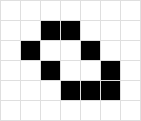
The dove (or R-mango or R-havoc) is a simple induction coil and nonoplet.
If left to evolve on its own, it stabilizes at generation 200 as a fairly sparse formation of 3 blocks and 2 blinkers.
The stairstep hexomino, if half of it is deleted after the two halves initially separate, forms a dove in 42 generations. The dove forms a lumps of muck sequence (although through a different predecessor) in what is effectively 20 generations. This is the basis of the p124 lumps of muck hassler; 2×(42+20) = 124.
As a still life component
As mentioned previously, it can act as an induction coil. Two doves suffice to make a still life, with five possible isomers:
A sixth still life exists in which physical connection between both dove exists:
Gallery
See alsoExternal links
|