Phoenix 1: Difference between revisions
No edit summary |
No edit summary |
||
| Line 38: | Line 38: | ||
== [[List of common oscillators|Commonness]] == | == [[List of common oscillators|Commonness]] == | ||
{{Needs occurrence info|type=oscillator}} | {{Needs occurrence info|type=oscillator}} | ||
Note that this section only concerns ''absolute'' natural occurrence - symmetric starting configurations are only counted as semi-natural. | |||
== [[Glider synthesis]] == | |||
{{Small constructible periodic object}} | |||
== Extensions == | == Extensions == | ||
Revision as of 21:48, 23 December 2021
| Phoenix 1 | |||||||||
| View animated image | |||||||||
| View static image | |||||||||
| Pattern type | Oscillator | ||||||||
|---|---|---|---|---|---|---|---|---|---|
| Oscillator type | Phoenix | ||||||||
| Number of cells | 12 | ||||||||
| Bounding box | 8 × 8 | ||||||||
| Frequency class | 41.4 | ||||||||
| Period | 2 (mod: 1) | ||||||||
| Heat | 24 | ||||||||
| Volatility | 1.00 | 1.00 | ||||||||
| Kinetic symmetry | Unspecified | ||||||||
| Rotor type | Flutter | ||||||||
| Discovered by | MIT group | ||||||||
| Year of discovery | 1971 | ||||||||
| |||||||||
| |||||||||
| |||||||||
| |||||||||
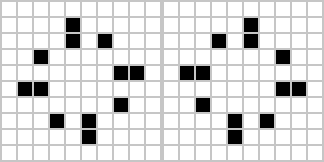
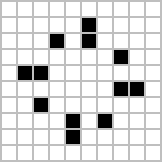
- This article is about the 12-cell oscillator. For the general concept, see Phoenix.
Phoenix 1 (or flip-flops[1]) is a period-2 oscillator that was discovered by the MIT group in December 1971.[2] It is the smallest known phoenix as well as the first discovered phoenix, and is thus sometimes simply referred to as the phoenix.
Phoenix 1 consists of four identical three-cell segments, chained in a loop. Other arrangements are possible, to generate larger period 2 phoenices as shown below. A single copy of this rotor can also be supported by a stator: this is an oscillator known as the griddle. The same rotor segment also appears in by flops and why not.
Despite its small size, it had not shown up naturally in soup until October 5, 2015, making it the last 12-bit object to appear naturally;[3] and another soup turned up with this object on October 23.[4] Both of these soups were found by Tomas Rokicki using apgsearch.
In even 90° rotational symmetry (C4_4), it is much more common, being the thirty-first most common object and the fourth most common period-2 oscillator according to Catagolue.
Information on this oscillator's commonness with respect to other naturally-occurring patterns is currently unknown.
Note that this section only concerns absolute natural occurrence - symmetric starting configurations are only counted as semi-natural.
All strict still lifes with a population of 23 or fewer cells, all oscillators with 16 or fewer cells, and all spaceships with 35 or fewer cells are known to be glider-constructible. A glider synthesis of this object can be found in the infobox to the right.
Extensions
Phoenix 1 is trivial to extend, yielding an infinite family of volatility-1 oscillators, an example shown below.
| An extension of phoenix 1 (click above to open LifeViewer) RLE: here Plaintext: here |
See also
References
- ↑ "Flip-flops". The Life Lexicon. Stephen Silver. Retrieved on June 21, 2011.
- ↑ Dean Hickerson's oscillator stamp collection. Retrieved on March 14, 2020.
- ↑ Adam P. Goucher (October 5, 2015). Re: Soup search results (discussion thread) at the ConwayLife.com forums
- ↑ Billabob (October 23, 2015). Re: Soup search results (discussion thread) at the ConwayLife.com forums
External links
- Phoenix 1 at the Life Lexicon
- 12P2.6 at Heinrich Koenig's Game of Life Object Catalogs
- Patterns
- Patterns with Catagolue frequency class 41
- Natural periodic objects
- Oscillators with 12 cells
- Periodic objects with minimum population 12
- Patterns with 12 cells
- Patterns found by MIT group
- Patterns found in 1971
- Patterns that can be constructed with 6 gliders
- Oscillators
- Phoenices
- Oscillators with period 2
- Oscillators with mod 1
- Oscillators with heat 24
- Oscillators with volatility 1.00
- Oscillators with strict volatility 1.00
- Oscillators with rotor Flutter
- Patterns with 90-degree rotation symmetry
- Flipping oscillators