Queen bee: Difference between revisions
added turning reaction |
mistype |
||
| Line 1: | Line 1: | ||
{{Pattern|bx=7|by=5|name=Queen bee|pname=queenbee|c=12|discoveryear=1970|life105=true|life106=true|plaintext=true|rle=true|synthesis=3|synthesisRLE=true}} | {{Pattern|bx=7|by=5|name=Queen bee|pname=queenbee|c=12|discoveryear=1970|life105=true|life106=true|plaintext=true|rle=true|synthesis=3|synthesisRLE=true}} | ||
'''Queen bee''' is a pattern that lays two [[beehive]]s before exploding. Because of the way in which | '''Queen bee''' is a pattern that lays two [[beehive]]s before exploding. Because of the way in which it lays those beehives, it is simple to stabilize into an [[oscillator]], as in the well-known [[queen bee shuttle]]. The term queen bee refers not just to the [[phase]] shown to the right, but also to any of the other phases of the pattern (excluding the beehives it creates) that occur before it explodes. | ||
==Turning reaction== | ==Turning reaction== | ||
Revision as of 22:22, 30 January 2010
| Queen bee | |||||||
| View static image | |||||||
| Pattern type | Miscellaneous | ||||||
|---|---|---|---|---|---|---|---|
| Number of cells | 12 | ||||||
| Bounding box | 7 × 5 | ||||||
| Static symmetry | Unspecified | ||||||
| Discovered by | Unknown | ||||||
| Year of discovery | 1970 | ||||||
| |||||||
| |||||||
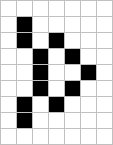
Queen bee is a pattern that lays two beehives before exploding. Because of the way in which it lays those beehives, it is simple to stabilize into an oscillator, as in the well-known queen bee shuttle. The term queen bee refers not just to the phase shown to the right, but also to any of the other phases of the pattern (excluding the beehives it creates) that occur before it explodes.
Turning reaction
One of the simplest reactions involves a queen bee involves colliding it with two gliders that come in from opposite directions in order to turn (reflect) it; this reaction was found by David Bell and was turned into a period 88 oscillator (shown below) on March 21, 1996. The reaction itself turns the queen bee counterclockwise by 90 degrees in 22 generations.[1]
 RLE: here |
 RLE: here |
Image gallery
 |
See also
References
- ↑ Jason Summers' jslife pattern collection. Retrieved on June 3, 2009.