72P68: Difference between revisions
Jump to navigation
Jump to search
Like 92P51 |
71P68 https://conwaylife.com/forums/viewtopic.php?p=151605#p151605 |
||
| Line 20: | Line 20: | ||
|apgcode = xp68_w32acy1ca23zy2sr7zo8a6y1mm0mp2c82u08ozy51qaic0d5521 | |apgcode = xp68_w32acy1ca23zy2sr7zo8a6y1mm0mp2c82u08ozy51qaic0d5521 | ||
}} | }} | ||
'''72P68''' is | '''72P68''' is a {{period|68}} [[oscillator]], consisting of a [[honey thieves]] variant interacting with an unnamed {{period|4}} oscillator. It was the smallest known [[non-trivial]] period-68 oscillator before discovery of [[71P68]] on October 1, 2022. | ||
==External links== | ==External links== | ||
{{LinkCatagolue|xp68_w32acy1ca23zy2sr7zo8a6y1mm0mp2c82u08ozy51qaic0d5521}} | * {{LinkCatagolue|xp68_w32acy1ca23zy2sr7zo8a6y1mm0mp2c82u08ozy51qaic0d5521}} | ||
[[Category:Unnamed periodic objects]] | [[Category:Unnamed periodic objects]] | ||
[[Category:Least-common-multiple oscillators]] | [[Category:Least-common-multiple oscillators]] | ||
Revision as of 06:58, 4 October 2022
| 72P68 | |||||||||
| View static image | |||||||||
| Pattern type | Oscillator | ||||||||
|---|---|---|---|---|---|---|---|---|---|
| Number of cells | 72 | ||||||||
| Bounding box | 22 × 20 | ||||||||
| Period | 68 (mod: 68) | ||||||||
| Heat | 17.82 | ||||||||
| Volatility | 0.57 | 0.02 | ||||||||
| Kinetic symmetry | Unspecified | ||||||||
| Discovered by | Unknown | ||||||||
| Year of discovery | Unknown | ||||||||
| |||||||||
| |||||||||
| |||||||||
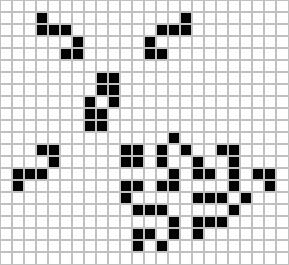
72P68 is a period-68 oscillator, consisting of a honey thieves variant interacting with an unnamed period-4 oscillator. It was the smallest known non-trivial period-68 oscillator before discovery of 71P68 on October 1, 2022.
External links
Categories:
- Patterns
- Oscillators with 72 cells
- Periodic objects with minimum population 72
- Patterns with 72 cells
- Oscillators
- Oscillators with period 68
- Oscillators with mod 68
- Oscillators with heat 17
- Oscillators with volatility 0.57
- Oscillators with strict volatility 0.02
- Unnamed periodic objects
- Least-common-multiple oscillators