Worker bee: Difference between revisions
B3-r/S23 |
In other rules |
||
| Line 26: | Line 26: | ||
|pentadecathlonid = 34P9.1 | |pentadecathlonid = 34P9.1 | ||
}} | }} | ||
'''Worker bee''' (or '''lonely bee'''<ref>{{cite web|url=http://codercontest.com/mniemiec/objname.htm#L|title=Life Objects Sorted by Name (L)|author=Mark D. Niemiec|accessdate=May 1, 2009}}</ref>) is a {{period|9}} [[oscillator]] and was found by [[David Buckingham]] in {{year|1972}}.<ref>{{CiteHickersonOscillators|accessdate=March 14, 2020}}</ref> | '''Worker bee''' (or '''lonely bee'''<ref>{{cite web|url=http://codercontest.com/mniemiec/objname.htm#L|title=Life Objects Sorted by Name (L)|author=Mark D. Niemiec|accessdate=May 1, 2009}}</ref>) is a {{period|9}} [[oscillator]] and was found by [[David Buckingham]] in {{year|1972}}.<ref>{{CiteHickersonOscillators|accessdate=March 14, 2020}}</ref> It consists of four [[eater 1]]s [[hassle|hassling]] a row of 6 live cells, which by itself is a dying [[spark]] that a lone [[table]] also converges to. | ||
Similar to the [[snacker]], the worker bee is extensible - it is, in fact, a finite version of the infinite [[one-cell-thick pattern|one-cell-thick]] oscillator consisting of alternating groups of six ON cells and two OFF cells. | |||
This oscillator first appeared [[semi-natural]]ly in April {{year|2015}}, in a [[symmetric]] [[soup]] submitted to [[Catagolue]] by [[Dave Greene]].<ref name="post18947" /> | This oscillator first appeared [[semi-natural]]ly in April {{year|2015}}, in a [[symmetric]] [[soup]] submitted to [[Catagolue]] by [[Dave Greene]].<ref name="post18947" /> | ||
==In other rules== | ==In other rules== | ||
By removing B3r, the worker bee needs no external support | |||
In other [[Life-like]] rules with transition S8, for instance [[EightLife]], the core of worker bee evolves into a [[honeycomb]], making the [[still life]] more common than that in regular Life. | |||
By removing the [[isotropic non-totalistic]] transition B3r, the worker bee needs no external support. A row of 6 cells becomes a small period-9 [[pipsquirter]]. | |||
{{EmbedViewer | |||
|rle = x = 6, y = 1, rule = B3-r/S23 | |||
6o! | |||
|position = center | |||
|viewerconfig = #C [[ THUMBNAIL THUMBSIZE 4 AUTOSTART GPS 3 LOOP 9 ]] | |||
|caption = The worker bee in B3-r/S23<br> | |||
}} | |||
==See also== | ==See also== | ||
*[[Snacker]] | * [[Snacker]] | ||
* [[68P9]] | |||
==References== | ==References== | ||
| Line 54: | Line 68: | ||
{{Symmetry|orthogonal4}} | {{Symmetry|orthogonal4}} | ||
{{seminatural}} | {{seminatural}} | ||
__NOTOC__ | |||
Revision as of 03:35, 2 August 2021
| Worker bee | |||||||||||
| View animated image | |||||||||||
| View static image | |||||||||||
| Pattern type | Oscillator | ||||||||||
|---|---|---|---|---|---|---|---|---|---|---|---|
| Number of cells | 34 | ||||||||||
| Bounding box | 16 × 11 | ||||||||||
| Period | 9 (mod: 9) | ||||||||||
| Heat | 15.6 | ||||||||||
| Volatility | 0.66 | 0.66 | ||||||||||
| Kinetic symmetry | Unspecified | ||||||||||
| Discovered by | David Buckingham | ||||||||||
| Year of discovery | 1972 | ||||||||||
| |||||||||||
| |||||||||||
| |||||||||||
| |||||||||||

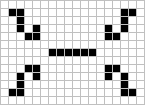
Worker bee (or lonely bee[1]) is a period-9 oscillator and was found by David Buckingham in 1972.[2] It consists of four eater 1s hassling a row of 6 live cells, which by itself is a dying spark that a lone table also converges to.
Similar to the snacker, the worker bee is extensible - it is, in fact, a finite version of the infinite one-cell-thick oscillator consisting of alternating groups of six ON cells and two OFF cells.
This oscillator first appeared semi-naturally in April 2015, in a symmetric soup submitted to Catagolue by Dave Greene.[3]
In other rules
In other Life-like rules with transition S8, for instance EightLife, the core of worker bee evolves into a honeycomb, making the still life more common than that in regular Life.
By removing the isotropic non-totalistic transition B3r, the worker bee needs no external support. A row of 6 cells becomes a small period-9 pipsquirter.
| The worker bee in B3-r/S23 (click above to open LifeViewer) |
See also
References
- ↑ Mark D. Niemiec. "Life Objects Sorted by Name (L)". Retrieved on May 1, 2009.
- ↑ Dean Hickerson's oscillator stamp collection. Retrieved on March 14, 2020.
- ↑ Dave Greene (April 23, 2015). Re: Soup search results (discussion thread) at the ConwayLife.com forums
External links
- Worker bee at the Life Lexicon
- 34P9.1 at Heinrich Koenig's Game of Life Object Catalogs
- Patterns
- Oscillators with 34 cells
- Periodic objects with minimum population 34
- Patterns with 34 cells
- Patterns found by David Buckingham
- Patterns found in 1972
- Patterns that can be constructed with 19 gliders
- Oscillators
- Oscillators with period 9
- Oscillators with mod 9
- Oscillators with heat 15
- Oscillators with volatility 0.66
- Oscillators with strict volatility 0.66
- Patterns with rectangular orthogonal symmetry
- Semi-natural periodic objects