|viewerconfig = #C [[ AUTOSTART THUMBSIZE 2 ZOOM 10 WIDTH 480 HEIGHT 1750 X 8 GPS 16 PAUSE 2 T 73 PAUSE 2 T 77 PAUSE 2 T 97 PAUSE 2 T 108 PAUSE 2 T 156 PAUSE 2 T 399 PAUSE 2 LOOP 157 ]]
|viewerconfig = #C [[ AUTOSTART THUMBSIZE 2 ZOOM 10 WIDTH 480 HEIGHT 1750 X 8 GPS 16 PAUSE 2 T 73 PAUSE 2 T 77 PAUSE 2 T 97 PAUSE 2 T 108 PAUSE 2 T 156 PAUSE 2 T 399 PAUSE 2 LOOP 157 ]]
}}
}}
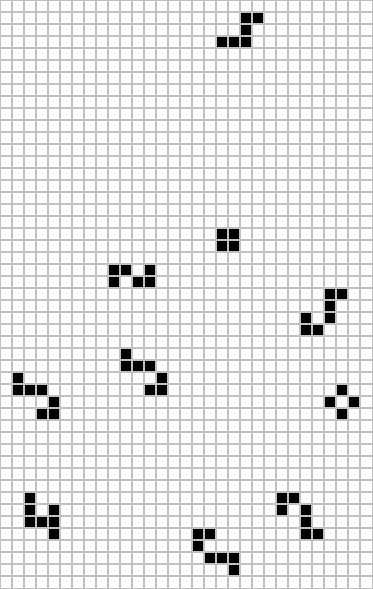
The third L156 variant produces an extra block, which is period-doubling. In the viewer, a Herschel coming 77 generations earlier will be blocked. For it not to be period-doubling, it must be:
The third L156 variant produces an extra block, which is period-doubling. In the viewer, a Herschel coming 77 generations earlier will be blocked. For it not to be period-doubling, it must be deleted using either a [[reflector]] (such as the [[p8 bumper]] + [[dependent conduit]]) or a set of conduits (e.g. [[R64]] + [[F117]], at the cost of impractically high repeat time).
# deleted using a [[reflector]] (such as the [[p8 bumper]] + [[dependent conduit]]);
# deleted using a set of conduits (e.g. [[R64]] + [[F117]]).
==See also==
== L156 as an injector ==
* [[L112]]
The [[BFx59H]] in the second variant of the L156 can act as an [[BFx59H injector|injector]].
Warning: The following viewer will pause 10 times.
The viewer below shows the injection of a [[Herschel]] into an existing track using a [[L156]]. [[Ghost Herschel]]s mark the output locations, and a [[duoplet]] marks the [[block]] produced in the period-doubling L156 in the northeast.
{{EmbedViewer
|position = center
|pname = l156reactions
|viewerconfig = #C [[ AUTOSTART THUMBSIZE 2 ZOOM 6 WIDTH 700 HEIGHT 900 GPS 20 X 3 PAUSE 2 T 73 PAUSE 2 T 97 PAUSE 2 T 156 PAUSE 2 T 220 PAUSE 2 T 231 PAUSE 2 T 293 PAUSE 2 T 295 PAUSE 2 T 317 PAUSE 2 T 328 PAUSE 2 T 376 PAUSE 2 T 826 PAUSE 2 LOOP 827 ]]
}}
* Pause 1: the Herschel reached [[generation]] 4 of the [[R-pentomino]].
* Pause 2: the Herschel reached the [[BFx59H]], the exact conduit that the gliders will be injecting into.
* Pause 3: the original Herschel reached the [[R64]] conduit. The gliders are in the position to be injected.
* Pause 4: the original Herschel passes the [[R64]]. The new Herschel is in the process of injecting.
* Pause 5: the new Herschel is successfully injected.
Pauses 6-10 show the procedure of removing the new [[Herschel]] that is up to 495 ticks separated. This does not work if the one Herschel is 503 or more ticks separated, and the conduit will break if the Herschels are separated by 496-502 generations.
* Pause 6: the original Herschel reached [[generation]] 4 of the [[R-pentomino]].
* Pause 7: the new Herschel passes the [[R64]]. By using an [[RNE-19T84]] instead of the standard [[L156]] catalyst, the new Herschel can be blocked.
* Pause 8: the original Herschel reached the [[BFx59H]]. It is in the position to block the new Herschel.
* Pause 9: the original Herschel (which is currently in a temporary [[R-pentomino]] phase in the [[BFx59H]]) leaves a [[block]] (in where the [[duoplet]] originally was), which will remove the new Herschel.
* Pause 10: the new Herschel was destroyed by the [[block]]. The original Herschel evolves normally, continuing along the Herschel track.
Note that you can instead remove the original Herschel by putting a [[block]] in the position of the [[duoplet]]. The 2 conduits above ([[R64]] and [[F117]]) and the welded [[eater 5]] makes sure that the block is always absent when a new Herschel 503+ generations later comes. This conduit does not work for Herschel spaced 496-502 generations apart.
Three variants are shown below. The first is the one in the infobox. The second uses an alternative RF28B to produce a glider in a different direction. The third uses an RNE-19T84 to produce two extra gliders and convert the conduit into a period doubler.
x = 74, y = 97, rule = B3/S23
19b2o38b2o$19bo39bo$17b3o37b3o16$17b2o38b2o$17b2o38b2o2$8b2obo36b2obo$
8bob2o36bob2o$26b2o$26bo$24bobo$24b2o2$9bo39bo$9b3o37b3o$o11bo27bo11bo
$3o8b2o14bo12b3o8b2o14bo$3bo22bobo14bo22bobo$2b2o23bo14b2o23bo4$64b2o$
64bobo$66bo$bo39bo24b2o$bobo37bobo18b2o$b3o37b3o18bo$3bo11b2o26bo11b2o
6b3o$15bo39bo9bo$16b3o37b3o$18bo39bo4$59b2o$59bo$57b3o16$57b2o$57b2o2$
48b2obo$48bob2o2$33b2o$33bo16bo$31bobo15bobo$31b2o16bobo$47b3ob2o20bo$
46bo24b3o$40bo6b3ob2o17bo$40b3o6bob2o17b2o$43bo$18bo23b2o$16b3o48b2o$
16bobo47bo2bo$16bo50b2o4$41bo$41bobo$30b2o9b3o$17b2o11b2o11bo11b2o$18b
o36bo$15b3o38b3o$15bo42bo!
#C [[ THUMBSIZE 2 THEME 6 GRID GRIDMAJOR 0 SUPPRESS THUMBLAUNCH ]]
#C [[ AUTOSTART THUMBSIZE 2 ZOOM 10 WIDTH 480 HEIGHT 1750 X 8 GPS 16 PAUSE 2 T 73 PAUSE 2 T 77 PAUSE 2 T 97 PAUSE 2 T 108 PAUSE 2 T 156 PAUSE 2 T 399 PAUSE 2 LOOP 157 ]]
The third L156 variant produces an extra block, which is period-doubling. In the viewer, a Herschel coming 77 generations earlier will be blocked. For it not to be period-doubling, it must be deleted using either a reflector (such as the p8 bumper + dependent conduit) or a set of conduits (e.g. R64 + F117, at the cost of impractically high repeat time).