Pentoad: Difference between revisions
Jump to navigation
Jump to search
m fixed see also |
m →See also: smallest |
||
| Line 13: | Line 13: | ||
*[[Biting off more than they can chew]] | *[[Biting off more than they can chew]] | ||
*[[Toad]] | *[[Toad]] | ||
*[[Smallest_period_five_oscillators|Smallest period five oscillators]] | |||
==References== | ==References== | ||
Revision as of 14:47, 19 June 2011
| Pentoad | |||||||
| View animated image | |||||||
| View static image | |||||||
| Pattern type | Oscillator | ||||||
|---|---|---|---|---|---|---|---|
| Number of cells | 20 | ||||||
| Bounding box | 13 × 12 | ||||||
| Period | 5 (mod: Unknown) | ||||||
| Heat | 8.8 | ||||||
| Volatility | Unknown | Unknown | ||||||
| Kinetic symmetry | Unspecified | ||||||
| Discovered by | Bill Gosper | ||||||
| Year of discovery | 1977 | ||||||
| |||||||
| |||||||

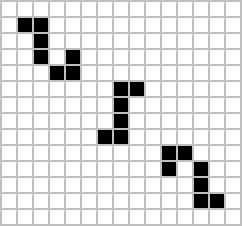
Pentoad (or eater-bound Z-hexomino[1]) is a period 5 oscillator that was found by Bill Gosper in June 1977. It consists of a Z-hexomino that is stabilized by two eater 1s.
It was discovered by Scott Kim that this oscillator is extensible by moving one of the eaters diagonally away by four cells and inserting another Z-hexomino in the gap. A pentoad constructed in this way with n Z-hexominoes has 14 + 6n cells and heat 8.8 + 6.4n. The pentoad with two Z-hexominoes is shown below.
Image gallery
 |
See also
References
- ↑ Mark D. Niemiec. "Eater-bound Z-hexomino glider synthesis RLE file". Retrieved on April 28, 2009.
External links
- Pentoad at the Life Lexicon