Tredecapole: Difference between revisions
Jump to navigation
Jump to search
m {{seminatural}} |
will cost 26G in next update |
||
| Line 19: | Line 19: | ||
|isorulemin = B3c/S2ae3n | |isorulemin = B3c/S2ae3n | ||
|isorulemax = B2ckn34-r5678/S1e2345678 | |isorulemax = B2ckn34-r5678/S1e2345678 | ||
| | |synthesis = 26 | ||
|plaintext = true | |plaintext = true | ||
|rle = true | |rle = true | ||
|viewerconfig = #C [[ LOOP 2 GPS 2 THUMBSIZE 3 WIDTH 480 HEIGHT 480 ]] | |viewerconfig = #C [[ LOOP 2 GPS 2 THUMBSIZE 3 WIDTH 480 HEIGHT 480 ]] | ||
|apgcode = xp2_y6g0k053zy280a02zg0k0501z11 | |apgcode = xp2_y6g0k053zy280a02zg0k0501z11 | ||
|animated = 1 | |||
}} | }} | ||
The '''tredecapole '''(or '''tridecapole''') is the [[barberpole]] of length 13. | The '''tredecapole '''(or '''tridecapole''') is the [[barberpole]] of length 13. | ||
Revision as of 23:26, 11 August 2019
| Tredecapole | |||||||||
| View animated image | |||||||||
| View static image | |||||||||
| Pattern type | Oscillator | ||||||||
|---|---|---|---|---|---|---|---|---|---|
| Oscillator type | Muttering moat | ||||||||
| Family | Barberpole | ||||||||
| Number of cells | 19 | ||||||||
| Bounding box | 16 × 16 | ||||||||
| Period | 2 (mod: 1) | ||||||||
| Heat | 26 | ||||||||
| Volatility | 0.81 | 0.81 | ||||||||
| Kinetic symmetry | Unspecified | ||||||||
| Rotor type | Pole 13 | ||||||||
| Discovered by | MIT group | ||||||||
| Year of discovery | 1970 | ||||||||
| |||||||||
| |||||||||
| |||||||||
| |||||||||
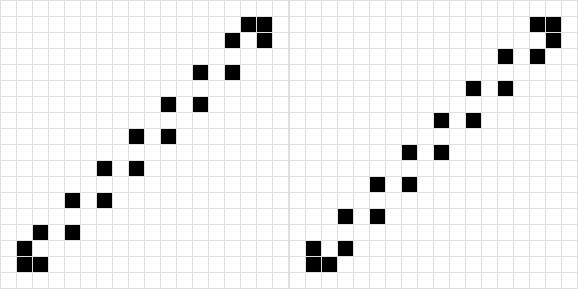
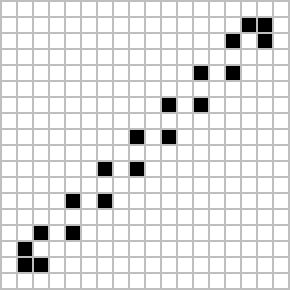
The tredecapole (or tridecapole) is the barberpole of length 13.
See also
External links
Categories:
- Patterns
- Oscillators with 19 cells
- Periodic objects with minimum population 19
- Patterns with 19 cells
- Patterns found by MIT group
- Patterns found in 1970
- Patterns that can be constructed with 26 gliders
- Oscillators
- Barberpole variants
- Muttering moats
- Oscillators with period 2
- Oscillators with mod 1
- Oscillators with heat 26
- Oscillators with volatility 0.81
- Oscillators with strict volatility 0.81
- Oscillators with rotor Pole 13
- Patterns with bilateral diagonal symmetry
- Flipping oscillators
- Semi-natural periodic objects