Undecapole: Difference between revisions
Jump to navigation
Jump to search
This is, as its name says, not a decapole |
m {{seminatural}} |
||
| Line 42: | Line 42: | ||
{{Symmetry|diagonal2|osc=flip}} | {{Symmetry|diagonal2|osc=flip}} | ||
{{seminatural}} | |||
Revision as of 00:03, 8 June 2019
| Undecapole | |||||||||
| View animated image | |||||||||
| View static image | |||||||||
| Pattern type | Oscillator | ||||||||
|---|---|---|---|---|---|---|---|---|---|
| Oscillator type | Muttering moat | ||||||||
| Family | Barberpole | ||||||||
| Number of cells | 17 | ||||||||
| Bounding box | 14 × 14 | ||||||||
| Period | 2 (mod: 1) | ||||||||
| Heat | 22 | ||||||||
| Volatility | 0.78 | 0.78 | ||||||||
| Kinetic symmetry | Unspecified | ||||||||
| Rotor type | Pole 11 | ||||||||
| Discovered by | MIT group | ||||||||
| Year of discovery | 1970 | ||||||||
| |||||||||
| |||||||||
| |||||||||
| |||||||||

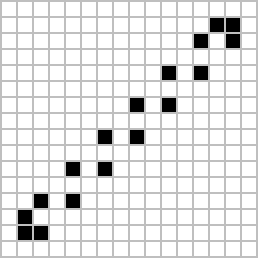
The undecapole (or hendecapole) is the barberpole of length 11. It is the largest barberpole so far to have occurred semi-naturally.
See also
External links
- 17P2.131 at Heinrich Koenig's Game of Life Object Catalogs
Categories:
- Patterns
- Oscillators with 17 cells
- Periodic objects with minimum population 17
- Patterns with 17 cells
- Patterns found by MIT group
- Patterns found in 1970
- Patterns that can be constructed with 18 gliders
- Oscillators
- Barberpole variants
- Muttering moats
- Oscillators with period 2
- Oscillators with mod 1
- Oscillators with heat 22
- Oscillators with volatility 0.78
- Oscillators with strict volatility 0.78
- Oscillators with rotor Pole 11
- Patterns with bilateral diagonal symmetry
- Flipping oscillators
- Semi-natural periodic objects