Bi-gun: Difference between revisions
Jump to navigation
Jump to search
m apgcode |
m format=linear growth |
||
| Line 21: | Line 21: | ||
==External links== | ==External links== | ||
{{LinkCatagolue|yl46_1_10_ace82e6a60e972a3a224b998d5e29b17}} | {{LinkCatagolue|yl46_1_10_ace82e6a60e972a3a224b998d5e29b17|format=linear growth}} | ||
{{Symmetry|180degree}} | {{Symmetry|180degree}} | ||
Revision as of 23:08, 13 June 2019
| Bi-gun | |||||||||
| View animated image | |||||||||
| View static image | |||||||||
| Pattern type | Gun | ||||||||
|---|---|---|---|---|---|---|---|---|---|
| Number of cells | 44 | ||||||||
| Bounding box | 56 × 17 | ||||||||
| Period | 46 | ||||||||
| Barrels | 2 | ||||||||
| Discovered by | Bill Gosper | ||||||||
| Year of discovery | Unknown | ||||||||
| |||||||||
| |||||||||
| |||||||||

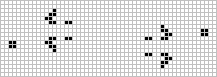
The bi-gun is a double-barreled glider gun that was found by Bill Gosper in the early 1970's.[1] Much like his Gosper glider gun works by colliding two queen bee shuttles together, the bi-gun works by colliding two twin bees shuttles together. Dietrich Leithner discovered that it can be synthesised with 12 gliders.
References
External links
- Bi-gun at Adam P. Goucher's Catagolue (linear growth)