Figure eight: Difference between revisions
No edit summary |
m templatified links and categories |
||
| Line 27: | Line 27: | ||
|viewerconfig = #C [[ GPS 4 THUMBSIZE 2 ]] | |viewerconfig = #C [[ GPS 4 THUMBSIZE 2 ]] | ||
}} | }} | ||
'''Figure eight''' (or less frequently, '''big [[beacon]]'''<ref>{{CiteLexicon|file=lex_b.htm#bigbeacon|name=Big beacon|accessdate=June 14, 2011}}</ref> or '''lemniscate''') is a | '''Figure eight''' (or less frequently, '''big [[beacon]]'''<ref>{{CiteLexicon|file=lex_b.htm#bigbeacon|name=Big beacon|accessdate=June 14, 2011}}</ref> or '''lemniscate''') is a {{period|8}} [[oscillator]] found by [[Simon Norton]] in {{year|1970}}. With {{cells|12}} [[cell]]s in its initial [[phase]], it is the smallest known period 8 oscillator, behind [[blocker]] at {{cells|15}} cells. It is known that no period 8 oscillators exist with 10 or fewer cells.<ref>{{cite web|url=http://codercontest.com/mniemiec/p8osc.htm |title=Life Period-8 Oscillators|author=Mark Niemiec|date=1998 |accessdate=February 5, 2009}}</ref> | ||
==As a building block for larger oscillators== | ==As a building block for larger oscillators== | ||
Because it produces a domino [[spark]] in one of its phases, it is useful for constructing larger oscillators that have period that is a multiple of eight. For example, it appears in [[tumbling T-tetson]] (period 8), [[sailboat]] (period | Because it produces a domino [[spark]] in one of its phases, it is useful for constructing larger oscillators that have period that is a multiple of eight. For example, it appears in [[tumbling T-tetson]] (period 8), [[sailboat]] (period {{period|16|brief}}), [[caterer on figure eight]] (the smallest period {{period|24|brief}} oscillator), and [[figure eight on 36P22]] (period {{period|88|brief}}). | ||
==As a reflector== | ==As a reflector== | ||
| Line 58: | Line 58: | ||
{{Symmetry|diagonal4}} | {{Symmetry|diagonal4}} | ||
{{Sparker|p=8|type=domino|strength=moderate}} | |||
__NOTOC__ | __NOTOC__ | ||
Revision as of 00:01, 27 December 2019
| Figure eight | |||||||||
| View animated image | |||||||||
| View static image | |||||||||
| Pattern type | Oscillator | ||||||||
|---|---|---|---|---|---|---|---|---|---|
| Number of cells | 12 | ||||||||
| Bounding box | 10 × 10 | ||||||||
| Frequency class | 23.4 | ||||||||
| Period | 8 (mod: 8) | ||||||||
| Heat | 16.5 | ||||||||
| Volatility | 1.00 | 1.00 | ||||||||
| Kinetic symmetry | Unspecified | ||||||||
| Discovered by | Simon Norton | ||||||||
| Year of discovery | 1970 | ||||||||
| |||||||||
| |||||||||
| |||||||||
| |||||||||
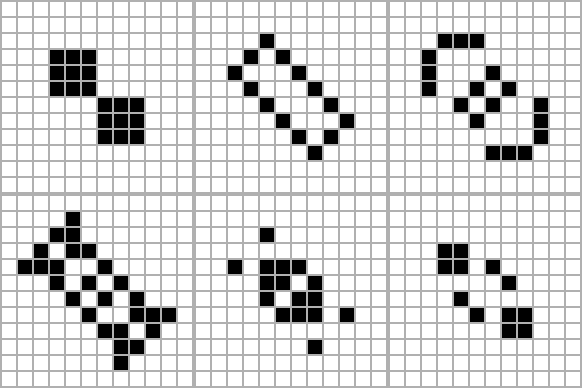
Figure eight (or less frequently, big beacon[1] or lemniscate) is a period-8 oscillator found by Simon Norton in 1970. With 12 cells in its initial phase, it is the smallest known period 8 oscillator, behind blocker at 15 cells. It is known that no period 8 oscillators exist with 10 or fewer cells.[2]
As a building block for larger oscillators
Because it produces a domino spark in one of its phases, it is useful for constructing larger oscillators that have period that is a multiple of eight. For example, it appears in tumbling T-tetson (period 8), sailboat (period 16), caterer on figure eight (the smallest period 24 oscillator), and figure eight on 36P22 (period 88).
As a reflector
Figure eight has the ability to act as a 90-degree glider reflector when it is combined with a block, boat and eater 1. The input path (in green) and output path (in red) of the glider are shown below.

RLE: here
Figure eight is the tenth most common naturally-occurring oscillator in Achim Flammenkamp's census, being less common than the great on-off but more common than the spark coil.[3] On Catagolue, it is the most common period 8 oscillator, being more common than blocker.[4]
Image gallery
-
 One of the phases of the oscillator, which led to both of its names.

See also
References
- ↑ "Big beacon". The Life Lexicon. Stephen Silver. Retrieved on June 14, 2011.
- ↑ Mark Niemiec (1998). "Life Period-8 Oscillators". Retrieved on February 5, 2009.
- ↑ Achim Flammenkamp (September 7, 2004). "Most seen natural occurring ash objects in Game of Life". Retrieved on January 15, 2009.
- ↑ Adam P. Goucher. "Statistics". Catagolue. Retrieved on October 27, 2018.
External links
- Figure-8 at the Life Lexicon
- 12P8.1 at Heinrich Koenig's Game of Life Object Catalogs
- Patterns
- Patterns with Catagolue frequency class 23
- Natural periodic objects
- Oscillators with 12 cells
- Periodic objects with minimum population 12
- Patterns with 12 cells
- Patterns found by Simon Norton
- Patterns found in 1970
- Patterns that can be constructed with 4 gliders
- Oscillators
- Oscillators with period 8
- Oscillators with mod 8
- Oscillators with heat 16
- Oscillators with volatility 1.00
- Oscillators with strict volatility 1.00
- Patterns with rectangular diagonal symmetry
- Sparkers
- Sparkers with period 8
- Domino sparkers
- Moderate sparkers