L156: Difference between revisions
Careful -- the added sentence about making a gun out of a period-62 Herschel track isn't true. 62 is the repeat time only if the FNG is suppressed. |
No edit summary |
||
| Line 32: | Line 32: | ||
If the block is not deleted, this conduit becomes a "semi-L156", which blocks every second Herschel, thus a period doubler. | If the block is not deleted, this conduit becomes a "semi-L156", which blocks every second Herschel, thus a period doubler. | ||
== L156 as an injector == | |||
The [[BFx59H]] in the second variant of the L156 can act as an [[BFx59H injector|injector]]. | |||
Warning: The following viewer will pause 10 times. | |||
The viewer below shows the reaction of injecting a [[Herschel]] into an existing track using a [[L156]]. [[Ghost herschel]]s mark the output locations, and a [[duoplet]] marks the [[block]] produced in the period-doubling L156 on the north-east | |||
{{EmbedViewer | |||
|position = center | |||
|pname = L156reactions | |||
|viewerconfig = #C [[ AUTOSTART THUMBSIZE 2 ZOOM 8 WIDTH 600 HEIGHT 800 X 6 Y -8 GPS 20 PAUSE 2 T 73 PAUSE 2 T 97 PAUSE 2 T 156 PAUSE 2 T 220 PAUSE 2 T 231 PAUSE 2 T 293 PAUSE 2 T 295 PAUSE 2 T 317 PAUSE 2 T 328 PAUSE 2 T 376 PAUSE 2 LOOP 377 ]] | |||
}} | |||
* In the first pause, the Herschel reached [[generation]] 4 of the [[R-pentomino]]. | |||
* In the second pause, the Herschel reached the [[BFx59H]], the exact conduit that the gliders will be injecting into. | |||
* In the third pause, the original Herschel reached the [[R64]] conduit. The gliders are in the position to be injected. | |||
* In the fourth pause, the original Herschel passes the [[R64]]. The new Herschel is in the process of injecting. | |||
* In the fifth pause, the new Herschel is successfully injected. | |||
In pauses 6-10, it shows the procedure of removing the new [[Herschel]]. | |||
* In the sixth pause, the original Herschel reached [[generation]] 4 of the [[R-pentomino]]. | |||
* In the seventh pause, the new Herschel passes the [[R64]]. By using an [[RNE-19T84]] instead of the standard [[L156]] catalyst, the new herschel can be blocked. | |||
* In the eighth pause, the original Herschel reached the [[BFx59H]]. It is in the position to block the new Herschel. | |||
* In the ninth pause, the original Herschel (which is currently in a temporary [[R-pentomino]] phase in the [[BFx59H]]) leaves a [[block]] (in where the [[duoplet]] originally was), which will remove the new Herschel. | |||
* In the tenth pause, the new Herschel was destroyed by the [[block]]. The original Herschel evolves normally, continuing along the Herschel track. | |||
Note that you can instead remove the original Herschel by putting a [[block]] in the position of the [[duoplet]]. | |||
==External links== | ==External links== | ||
{{LinkLexicon|lex_l.htm#l156}} | {{LinkLexicon|lex_l.htm#l156}} | ||
Revision as of 21:17, 27 October 2018
| L156 | |||||
| View static image | |||||
| Pattern type | Conduit | ||||
|---|---|---|---|---|---|
| Conduit type | Composite | ||||
| Input | Herschel | ||||
| Number of cells | 56 | ||||
| Output orientation | Turned left | ||||
| Output offset | (17, -41) | ||||
| Step | 156 ticks | ||||
| Recovery time (ignoring FNG if any) |
62 ticks | ||||
| Minimum overclock period (ignoring FNG if any) |
Unknown | ||||
| Spartan? | Yes | ||||
| Dependent? | No | ||||
| Discovered by | David Buckingham | ||||
| Year of discovery | 1996 | ||||
| |||||
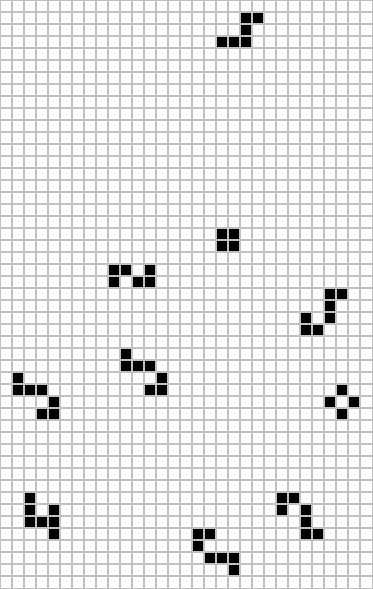
L156 is a composite conduit, one of the original sixteen Herschel conduits, discovered by Dave Buckingham in August 1996. It is made up of three elementary conduits, HLx69R, RF28B, and BFx59H. After 156 ticks, it produces a Herschel turned 90 degrees counterclockwise at (17, -41) relative to the input. Its recovery time is 62 ticks. It can be made Spartan by replacing the snake with an eater 1 in one of two orientations. In the pattern shown in the infobox, a ghost Herschel marks the output location.
Three variants are shown below. The first is the one in the infobox. The second uses an alternative RF28B to produce a glider in a different direction. The third uses an RNE-19T84 to produce 2 extra gliders.
| (click above to open LifeViewer) RLE: here Plaintext: here |
The third L156 variant produces an extra block, which must be
- deleted using a reflector (such as the p8 bumper + dependent conduit, as shown in the embedded LifeViewer pattern above);
- deleted using a set of conduits (e.g. R64 + F117);
If the block is not deleted, this conduit becomes a "semi-L156", which blocks every second Herschel, thus a period doubler.
L156 as an injector
The BFx59H in the second variant of the L156 can act as an injector.
Warning: The following viewer will pause 10 times.
The viewer below shows the reaction of injecting a Herschel into an existing track using a L156. Ghost herschels mark the output locations, and a duoplet marks the block produced in the period-doubling L156 on the north-east
| (click above to open LifeViewer) RLE: here Plaintext: here |
- In the first pause, the Herschel reached generation 4 of the R-pentomino.
- In the second pause, the Herschel reached the BFx59H, the exact conduit that the gliders will be injecting into.
- In the third pause, the original Herschel reached the R64 conduit. The gliders are in the position to be injected.
- In the fourth pause, the original Herschel passes the R64. The new Herschel is in the process of injecting.
- In the fifth pause, the new Herschel is successfully injected.
In pauses 6-10, it shows the procedure of removing the new Herschel.
- In the sixth pause, the original Herschel reached generation 4 of the R-pentomino.
- In the seventh pause, the new Herschel passes the R64. By using an RNE-19T84 instead of the standard L156 catalyst, the new herschel can be blocked.
- In the eighth pause, the original Herschel reached the BFx59H. It is in the position to block the new Herschel.
- In the ninth pause, the original Herschel (which is currently in a temporary R-pentomino phase in the BFx59H) leaves a block (in where the duoplet originally was), which will remove the new Herschel.
- In the tenth pause, the new Herschel was destroyed by the block. The original Herschel evolves normally, continuing along the Herschel track.
Note that you can instead remove the original Herschel by putting a block in the position of the duoplet.
External links
- L156 at the Life Lexicon