22P36: Difference between revisions
Jump to navigation
Jump to search
Apple Bottom (talk | contribs) No edit summary |
Apple Bottom (talk | contribs) sv |
||
| Line 8: | Line 8: | ||
|h = 19.2 | |h = 19.2 | ||
|v = 0.89 | |v = 0.89 | ||
|sv = 0.89 | |||
|discoverer = Noam Elkies | |discoverer = Noam Elkies | ||
|discoveryear = 1995 | |discoveryear = 1995 | ||
Revision as of 11:55, 31 August 2017
| 22P36 | |||||||||
| View animated image | |||||||||
| View static image | |||||||||
| Pattern type | Oscillator | ||||||||
|---|---|---|---|---|---|---|---|---|---|
| Number of cells | 22 | ||||||||
| Bounding box | 14 × 18 | ||||||||
| Period | 36 (mod: Unknown) | ||||||||
| Heat | 19.2 | ||||||||
| Volatility | 0.89 | 0.89 | ||||||||
| Kinetic symmetry | Unspecified | ||||||||
| Discovered by | Noam Elkies | ||||||||
| Year of discovery | 1995 | ||||||||
| |||||||||
| |||||||||
| |||||||||
| |||||||||

- For the period 22 oscillator, see 36P22.
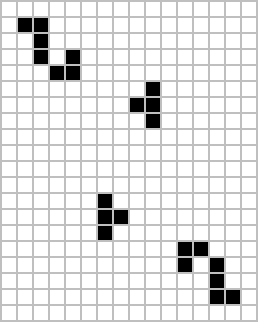
22P36 is an unnamed period 36 oscillator found by Noam Elkies on January 29, 1995.[1] It consists of a double hassling action, in which two colliding traffic lights (a traffic jam in fact) is first converted by eater 1s into a pair of blinkers and L-sparks. These produce then a pair of phi sparks, which are then hassled by the same eaters to produce T-tetrominoes, which re-evolve to traffic lights. In terms of its 22 cells it is the smallest period 36 oscillator.
References
- ↑ Dean Hickerson's oscillator stamp collection. Retrieved on June 16, 2009.
External links
Categories:
- Patterns
- Oscillators with 22 cells
- Periodic objects with minimum population 22
- Patterns with 22 cells
- Patterns found by Noam Elkies
- Patterns found in 1995
- Patterns that can be constructed with 9 gliders
- Oscillators
- Oscillators with period 36
- Oscillators with heat 19
- Oscillators with volatility 0.89
- Oscillators with strict volatility 0.89
- Patterns with 180-degree rotation symmetry