Sawtooth 201: Difference between revisions
m 1142941759764480 = 234224640*(47^4+1) |
No edit summary |
||
| Line 1: | Line 1: | ||
{{Pattern|type=Sawtooth|name=Sawtooth 201|discoverer=Adam P. Goucher|discoveryear=2015|pname=sawtooth201|c=201|bx= | {{Pattern|type=Sawtooth|name=Sawtooth 201|discoverer=Adam P. Goucher|discoveryear=2015|pname=sawtooth201|c=201|bx=79|by=55|rle=true}} | ||
'''Sawtooth 201''' is a diagonal [[sawtooth]] discovered on April 13th, 2015, and is currently the smallest known sawtooth in terms of its minimum repeating population of 201 and in terms of its bounding box. It functions by letting two glider streams of period 46 retract a block, created by collision with a spark from a [[58P5H1V1]], one cell at a time. The retracted block is deleted via interaction with a [[blocker]], and the streams are allowed to return to the now-farther-away 58P5H1V1 to create another block. | '''Sawtooth 201''' is a diagonal [[sawtooth]] discovered on April 13th, 2015, and is currently the smallest known sawtooth in terms of its minimum repeating population of 201 and in terms of its bounding box. It functions by letting two glider streams of period 46 retract a block, created by collision with a spark from a [[58P5H1V1]], one cell at a time. The retracted block is deleted via interaction with a [[blocker]], and the streams are allowed to return to the now-farther-away 58P5H1V1 to create another block. | ||
==Population== | |||
The population is equal to 201 at generations 0, 1840, 88320, 4152880, 195187200, 9173800240, 431168613120, ... (OEIS [http://oeis.org/A257319 A257319]), giving an expansion factor of 47. | |||
==History== | |||
The original design by [[Tanner Jacobi]] used a twin bees shuttle to delete the retracted block, resulting in a population of 213. [[Adam P. Goucher]] noticed that a blocker would suffice on the same day, reducing the population to 201. [[Dave Greene]] optimised the bounding box of the pattern by moving the blocker and spaceship inwards by two full-diagonals and rephasing the blocker by 4 generations; this also reduced the expansion factor from 47^4 to 47. | |||
Due to a mismatch between the period 46 guns and the period 5 spaceship in the original pattern, full retraction only resulted in the minimum population every fourth cycle. The expansion factor of this pattern is asymptotic to 47 if each of the four sub-tooths per cycle is counted as a separate peak; otherwise the expansion factor is 47^4 = 4,879,681. For the original version of Sawtooth 201, the minimum population recurs at T=0, T=234224640, T=1142941759764480, etc. For Sawtooth 213, the spaceship starts a few cells closer, which makes a big difference to the speed of the cycles, but not to the expansion factor: T=0, T=11232640, T=547659593220480, T=2672404111505817299520, and so on. | |||
==External links== | ==External links== | ||
*[http://www.conwaylife.com/forums/viewtopic.php?f=2&t=1590#p18666 Smaller Sawtooth] thread on conwaylife.com forums. | *[http://www.conwaylife.com/forums/viewtopic.php?f=2&t=1590#p18666 Smaller Sawtooth] thread on conwaylife.com forums. | ||
Revision as of 15:58, 20 April 2015
| Sawtooth 201 | |||||
| View static image | |||||
| Pattern type | Sawtooth | ||||
|---|---|---|---|---|---|
| Number of cells | 201 | ||||
| Bounding box | 79 × 55 | ||||
| Static symmetry | Unspecified | ||||
| Discovered by | Adam P. Goucher | ||||
| Year of discovery | 2015 | ||||
| |||||
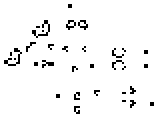
Sawtooth 201 is a diagonal sawtooth discovered on April 13th, 2015, and is currently the smallest known sawtooth in terms of its minimum repeating population of 201 and in terms of its bounding box. It functions by letting two glider streams of period 46 retract a block, created by collision with a spark from a 58P5H1V1, one cell at a time. The retracted block is deleted via interaction with a blocker, and the streams are allowed to return to the now-farther-away 58P5H1V1 to create another block.
Population
The population is equal to 201 at generations 0, 1840, 88320, 4152880, 195187200, 9173800240, 431168613120, ... (OEIS A257319), giving an expansion factor of 47.
History
The original design by Tanner Jacobi used a twin bees shuttle to delete the retracted block, resulting in a population of 213. Adam P. Goucher noticed that a blocker would suffice on the same day, reducing the population to 201. Dave Greene optimised the bounding box of the pattern by moving the blocker and spaceship inwards by two full-diagonals and rephasing the blocker by 4 generations; this also reduced the expansion factor from 47^4 to 47.
Due to a mismatch between the period 46 guns and the period 5 spaceship in the original pattern, full retraction only resulted in the minimum population every fourth cycle. The expansion factor of this pattern is asymptotic to 47 if each of the four sub-tooths per cycle is counted as a separate peak; otherwise the expansion factor is 47^4 = 4,879,681. For the original version of Sawtooth 201, the minimum population recurs at T=0, T=234224640, T=1142941759764480, etc. For Sawtooth 213, the spaceship starts a few cells closer, which makes a big difference to the speed of the cycles, but not to the expansion factor: T=0, T=11232640, T=547659593220480, T=2672404111505817299520, and so on.
External links
- Smaller Sawtooth thread on conwaylife.com forums.