Bipole: Difference between revisions
Jump to navigation
Jump to search
No edit summary |
No edit summary |
||
| Line 16: | Line 16: | ||
{{LinkWeisstein|filename=Bipole.html}} | {{LinkWeisstein|filename=Bipole.html}} | ||
{{LinkLexicon|filename=lex_b.htm#bipole}} | {{LinkLexicon|filename=lex_b.htm#bipole}} | ||
{{Symmetry|180degree|osc=flip}} | |||
Revision as of 20:08, 29 March 2016
| Bipole | |||||||
| View animated image | |||||||
| View static image | |||||||
| Pattern type | Oscillator | ||||||
|---|---|---|---|---|---|---|---|
| Number of cells | 8 | ||||||
| Bounding box | 5 × 5 | ||||||
| Period | 2 (mod: Unknown) | ||||||
| Heat | 4 | ||||||
| Volatility | 0.40 | 0.40 | ||||||
| Kinetic symmetry | Unspecified | ||||||
| Discovered by | Unknown | ||||||
| Year of discovery | 1970 | ||||||
| |||||||
| |||||||
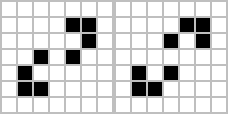

The bipole is the barberpole of length 2 and is thus an oscillator of period 2. It is the seventh most common oscillator, being less common than the clock and pentadecathlon but more common than the quadpole.[1] It has the same rotor as the blinker.
See also
References
- ↑ Achim Flammenkamp (September 7, 2004). "Most seen natural occurring ash objects in Game of Life". Retrieved on January 15, 2009.
External links
- Bipole at the Life Lexicon
Categories:
- Patterns
- Oscillators with 8 cells
- Periodic objects with minimum population 8
- Patterns with 8 cells
- Patterns found in 1970
- Patterns that can be constructed with 5 gliders
- Oscillators
- Oscillators with period 2
- Oscillators with heat 4
- Oscillators with volatility 0.40
- Oscillators with strict volatility 0.40
- Patterns with 180-degree rotation symmetry
- Flipping oscillators