Bipole: Difference between revisions
Jump to navigation
Jump to search
mNo edit summary |
mNo edit summary |
||
| Line 3: | Line 3: | ||
==See also== | ==See also== | ||
*[[Heptapole]] | |||
*[[Hexapole]] | |||
*[[List of common oscillators]] | |||
*[[Pentapole]] | |||
*[[Quadpole]] | |||
*[[Tripole]] | *[[Tripole]] | ||
==References== | ==References== | ||
Revision as of 03:30, 16 January 2009
| Bipole | |||||||
| View animated image | |||||||
| View static image | |||||||
| Pattern type | Oscillator | ||||||
|---|---|---|---|---|---|---|---|
| Number of cells | 8 | ||||||
| Period | 2 (mod: Unknown) | ||||||
| Heat | Unknown | ||||||
| Volatility | Unknown | Unknown | ||||||
| Kinetic symmetry | Unspecified | ||||||
| Discovered by | Unknown | ||||||
| Year of discovery | 1970 | ||||||
| |||||||
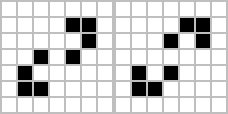

The bipole is the barberpole of length 2 and is thus an oscillator of period 2. It is the seventh most common oscillator, being less common than the clock and pentadecathlon but more common than the quadpole.[1]
See also
References
- ↑ Achim Flammenkamp (September 7, 2004). "Most seen natural occurring ash objects in Game of Life". Retrieved on January 15, 2009.
External links
Bipole at the Life Lexicon